Roofing Services in Nueva Andalucía
Professional roofing services for Costa del Sol properties.
Roofing, Waterproofing, and Roof Renovation in Nueva Andalucía: The Premium Guide for Property Owners
As the founder of costadelsolhabitat.com, I have spent years coordinating bespoke property maintenance services for international villa owners, family estates, and premium community members across the Costa del Sol. Within the municipality of Marbella, there is one area that demands a uniquely sophisticated approach to property care: the Distrito de Nueva Andalucía.
Known globally as the "Golf Valley" (Valle del Golf), this western district of Marbella is bordered to the west by the Guadaiza River (separating us from San Pedro Alcántara), to the east by the Verde River, to the north by Benahavís, Istán, and the La Concepción reservoir, and to the south by the Mediterranean shoreline at Puerto Banús. It is an area defined by its dramatic south-facing hillside terrain, rising from the sea toward the majestic backdrop of La Concha mountain.
With a permanent population of 17,727 residents (representing roughly 12.6% of Marbella's municipal total), Nueva Andalucía sees its population swell by at least 30% during the summer months. More importantly, the foreign resident profile here is exceptionally high—far exceeding Marbella’s overall average of 36.5% (which accounts for 63,206 registered expats from 155 nationalities out of a total municipal register of 173,420 as of early 2026). In premium urbanisations like Aloha, Las Brisas, Los Naranjos Golf, Magna Marbella, and Las Lomas de Nueva Andalucía, the community is overwhelmingly international. British, Scandinavian (particularly Swedish), German, Belgian, Dutch, and French owners dominate the luxury villa and golf-front apartment segments, alongside a rapidly growing Colombian demographic and established Ukrainian and Russian families.
For these discerning owners, a home in Nueva Andalucía is a major asset. Yet, the very elements that make this location a paradise—intense Mediterranean sun, marine salinity, and the dramatic topography of the Golf Valley—present severe challenges to roofs, terraces, and structural waterproofing.
The Microclimate of the Golf Valley: Why Roofs Fail in Nueva Andalucía
Many international owners assume that because Marbella enjoys roughly 2,900 hours of sunshine a year, roofing and waterproofing are secondary concerns. In reality, our unique microclimate subjected to the Costa del Sol Occidental dynamics accelerates the degradation of building envelopes.
1. Extreme UV Radiation and Thermal Shock
During the summer, daytime temperatures regularly exceed 30°C, and the UV Index frequently climbs to 9 or 10 ("very high" to "extreme") at midday from June to August. This intense solar radiation causes rapid degradation of exposed waterproofing membranes, polyurethane foams, joint sealants, and protective coatings. Furthermore, the district experiences the terral—a hot, dry wind from the north that can cause sudden, extreme temperature spikes. When this intense heat is followed by cooler night-time sea breezes (brisas marinas), the resulting thermal expansion and contraction cause micro-cracks in roof tiles, mortar joints, and terrace grouting.
2. High Salinity (Salitre) and Wind Alternation
The climate is characterized by the alternation of the Levante (a humid, easterly wind bringing moisture from the sea) and the Poniente (a drier westerly wind). Because Nueva Andalucía rises directly from the coast at Puerto Banús up into the hills, the lower areas suffer from high atmospheric salinity (salitre). Salt spray settles on roofs and terraces, crystallizing in porous materials and accelerating the corrosion of metal flashings, gutter systems, and structural reinforcements.
3. Torrential Winter Rains
While we enjoy dry summers, our annual rainfall averages approximately 645.8 mm, often concentrated in heavy, torrential downpours between November and March. When these intense rains hit flat roofs (cubiertas transitables) or tiled roofs that have suffered from summer cracking, water penetrates instantly. A minor, unnoticed hairline crack in August becomes a major ceiling leak and structural damp issue by December.
Common Roofing and Waterproofing Challenges in Local Urbanisations
Depending on where your property is located within the district, the architectural style and environmental exposures present distinct maintenance requirements.
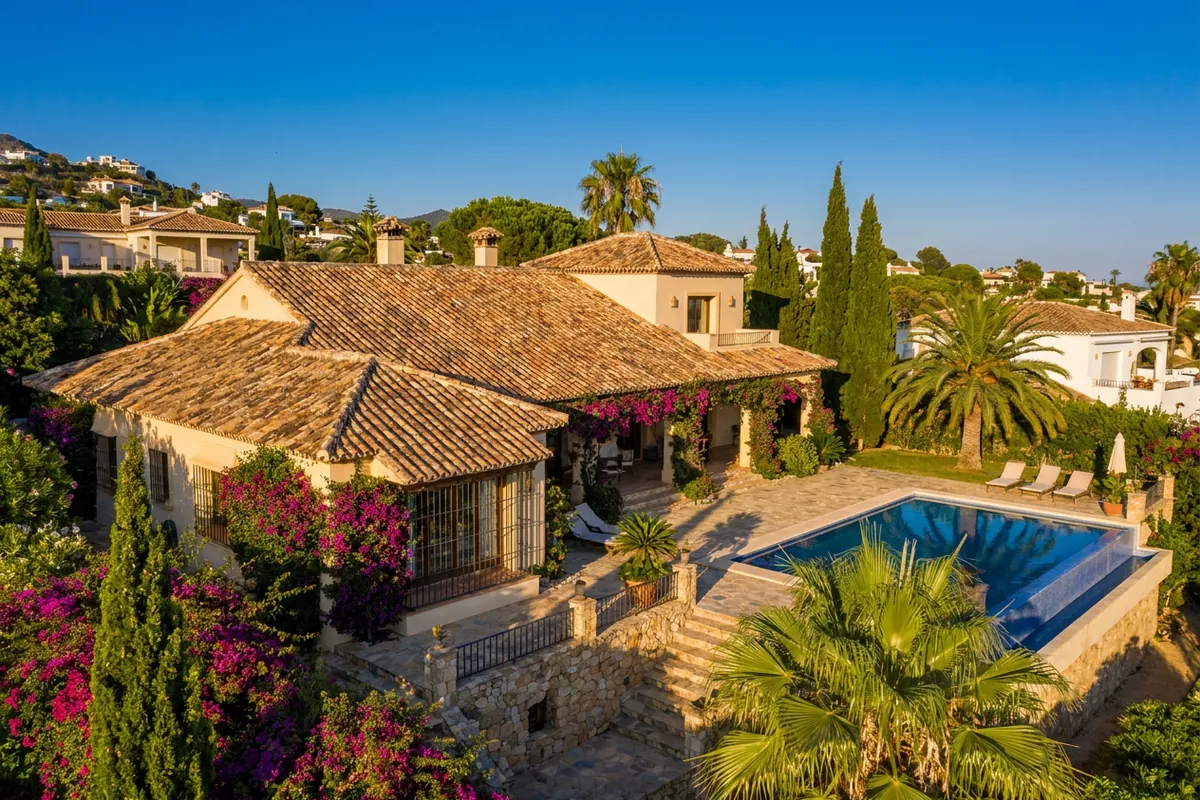
Traditional Andalusian Roofs in Aloha Pueblo and Las Lomas
In older, highly sought-after developments like Aloha Pueblo or traditional villas in Las Lomas de Nueva Andalucía, pitched roofs with curved clay tiles (tejas árabes) are common.
- The Issue: Over time, the mortar securing these tiles degrades due to wind, thermal movement, and bird nesting. Loose tiles shift, allowing rainwater to bypass the primary barrier.
- The Solution: Traditional roof restoration involves removing the tiles, applying a modern under-tile waterproofing membrane (such as asphalt-based sheets or high-performance elastomeric liquid membranes), and then reinstating the tiles using mechanical fixings and specialized flexible adhesives rather than rigid mortar.
Modernist Flat Roofs and Solariums in Las Brisas and Los Naranjos
The luxury villas lining the fairways of Real Club de Golf Las Brisas and Los Naranjos Golf often feature contemporary flat roofs, expansive solariums, and integrated outdoor living spaces complete with summer kitchens and hot tubs.
- The Issue: These flat roofs (cubiertas planas) double as living spaces. The waterproofing layer is buried beneath heavy tiling or decking. If the original asphalt membrane (tela asfáltica) or polyurethane liquid membrane was poorly installed, leaks will develop. Locating a leak beneath high-end porcelain tiles is notoriously difficult and costly.
- The Solution: We advocate for premium multi-layer waterproofing systems. This includes high-density polyurethane or polyurea hot-spray membranes that form a seamless, elastic barrier. Proper insulation (extruded polystyrene - XPS) must be integrated to prevent condensation issues inside the luxury interiors below.
Navigating Local Regulations, Permits, and Community Rules
Executing a roofing or waterproofing project in Nueva Andalucía requires strict adherence to local administrative and community frameworks. This is not an area where you should hire unlicensed contractors to work "quietly."
Ayuntamiento de Marbella: Urban Planning and Permits
Nueva Andalucía is a district under the jurisdiction of the Ayuntamiento de Marbella and has its own local district office (Tenencia de Alcaldía), but all urban planning and building permits are managed by the central municipal department.
Following the landmark Supreme Court ruling in 2015 that annulled the PGOU-2010 (the municipal master plan), Marbella’s urban planning reverted largely to the PGOU-1986, supplemented by subsequent adaptations, while the new Plan General de Ordenación Municipal (PGOM) continues its administrative journey. Because of this complex legal landscape, it is essential to verify the specific zoning and plot classification (calificación de la parcela) before undertaking structural changes.
- Obra Menor (Minor Works): For straightforward roof repairs, replacing damaged tiles, waterproofing an existing terrace without changing its structure, or installing non-structural elements like pergolas, awnings, or glass curtains, you can typically proceed via a Declaración Responsable (Responsible Declaration) or simplified license. This is a faster administrative route that allows work to begin once the fees are paid and the documentation is stamped by the town hall.
- Obra Mayor (Major Works): If your roof renovation involves structural changes—such as raising the roofline, adding a new solarium staircase, reinforcing load-bearing beams, or constructing a heavy permanent outdoor kitchen on a terrace—you must obtain an Obra Mayor license. This requires a formal project signed by an architect registered with the official college (Colegio Oficial de Arquitectos), technical reviews, and can take several months to be formally granted by the Ayuntamiento.
- Ley de Costas (Coastal Law): For properties located close to the beachfront in the Puerto Banús sector, the Spanish Coastal Law imposes strict protection easements (servidumbre de protección of 100 meters, reduced to 20 meters in established urban zones) and transit easements. Any exterior renovation in these zones requires explicit authorization from the regional coastal department before municipal permits can be issued.
Comunidad de Propietores (Homeowners' Associations)
The vast majority of premium properties in Nueva Andalucía are situated within private communities or gated urbanisations.
- Esthetics and Approval: Any external modification—including the choice of roof tile color, terrace tiling, glass balustrades, bioclimatic pergolas, or exterior chimneys—must be formally approved by the Community of Owners (Comunidad de Propietores).
- Structural Responsibility: In many apartment complexes and townhouses, the roof and the structural slab of the terraces are legally classified as "common elements for private use" (elementos comunes de uso privado). If a terrace leaks and damages the apartment below, determining whether the repair is the financial responsibility of the individual owner or the community depends on the origin of the leak (e.g., wear and tear of the surface tile vs. failure of the structural waterproofing membrane). Navigating these disputes requires clear technical reports and professional mediation.
Pest Control, Salinity, and Environmental Protection for Roofs
A roof in Nueva Andalucía does not exist in a vacuum; it is part of a delicate local ecosystem. When renovating or repairing a roof, several local environmental factors must be integrated into the technical plan:
- Bird-Proofing and Salitre Protection: The proximity to the coast means seagulls and pigeons are highly active. Nesting birds block gutters, and their acidic droppings rapidly corrode metal roof flashings and damage protective coatings. During any roof renovation, we recommend installing subtle, humane bird-proofing systems (such as stainless-steel spikes or tensioned wires) and ensuring all exposed metalwork is made of marine-grade stainless steel (316) or treated with high-durability anti-saline coatings.
- Termite and Wood-Boring Insect Prevention: For traditional villas with exposed wooden beams or rustic pergolas, termites and wood-boring beetles (carcoma) are a serious threat in the warm, humid climate of the Costa del Sol. Any timber used in roof renovations must be pressure-treated (Class 4 autoclave) and treated with specific insecticidal and fungicidal barriers.
- Processionary Caterpillars (Procesionaria del Pino): While not directly a roofing issue, many luxury villas in the Golf Valley are surrounded by mature pine trees. During the late winter and early spring, processionary caterpillars descend from these trees. If your roof or terrace gutters are filled with fallen pine needles, they create damp, acidic blockages that accelerate the deterioration of waterproofing membranes. Regular gutter cleaning is an absolute necessity.
Practical Timelines and Project Management for International Owners
For non-resident owners, managing a construction project in Spain from abroad can be daunting. The process requires a trusted local partner to coordinate the various professional steps.
Legal and Administrative Steps
If you are purchasing a property that requires immediate roof renovation, or if you are planning a major upgrade to an existing estate, the administrative workflow generally follows this path:
- Technical Survey: A qualified local surveyor (aparejador) or architect conducts a moisture mapping and structural assessment.
- Legal Representation: Your lawyer (abogado) or fiscal representative (gestor) verifies the property's planning status at the Marbella Ayuntamiento and checks for any outstanding community debts or building infractions.
- NIE and Notary: For non-residents, ensuring your Spanish Tax Number (NIE) is active and granting a Power of Attorney (POA) to your legal representative allows them to sign municipal documents, pay building taxes, and interface with the notary if structural changes need to be registered in the Property Registry (Registro de la Propiedad).
Project Timelines
While every project varies based on scale, general timelines in the Marbella region typically align with these ranges:
- Minor Waterproofing & Tiling Repairs: 1 to 3 weeks of active on-site work, usually manageable under a Declaración Responsable with immediate start.
- Complete Roof Strip and Re-tile (Standard Villa): 4 to 8 weeks, depending on weather conditions. It is highly recommended to schedule these works between May and September to avoid the risk of autumn downpours exposing the open roof structure.
- Major Roof and Terrace Structural Renovation: 3 to 6 months, including the time required to secure an Obra Mayor license from the Ayuntamiento de Marbella (which can take anywhere from 3 to 9 months for approval, depending on the complexity of the project and current municipal backlogs).
By understanding the unique environmental, legal, and community dynamics of Nueva Andalucía, you can ensure your roofing or waterproofing project is executed to the highest standards. This protects your investment, preserves the structural integrity of your luxury home, and allows you to enjoy the unparalleled lifestyle of the Golf Valley with complete peace of mind.
Frequently Asked Questions
How much does Roofing Services in Nueva Andalucía cost? ▼
The typical fee for Roofing Services in Nueva Andalucía is EUR 300–5,000 depending on scope. We provide a transparent quote before any commitment.
Do you cover Nueva Andalucía and surrounding areas? ▼
Yes, we connect you with vetted professionals covering Nueva Andalucía and all nearby towns including Marbella, San Pedro de Alcántara.
How long does Roofing Services take? ▼
Processing times vary, but most Roofing Services cases in the Nueva Andalucía area are completed within 2-8 weeks depending on complexity.
Other Home Services in Nueva Andalucía
Property Management in Nueva Andalucía
Already own a property? We manage holiday rentals, long-term lets, and keyholding.
View Property Management in Nueva Andalucía →Also Serving Nearby
Get Your Free Property Assessment
Tell us your name and how to reach you. We respond within 2 hours.
or message us directly
WhatsApp Us Now