Solar Panel Installation in Marbella
Professional solar panel installation for Costa del Sol properties.
The Marbella Energy Transition: Why Solar PV and Aerotermia Are the Ultimate Power Couple for Golden Mile Estates
For over a decade, coordinating property maintenance and managing luxury villas across the Costa del Sol Occidental has given me a front-row seat to the unique operational challenges of Marbella’s premium homes. Whether it is a sprawling, modern estate in the hills of Sierra Blanca, a frontline beach villa in Las Chapas, or a golf-front property in the heart of Nueva Andalucía’s Valle del Golf, large homes here have an insatiable appetite for energy.
Marbella’s climate is legendary, boasting approximately 2,900 sun hours per year. However, keeping a high-spec home comfortable year-round is an expensive endeavor. In the summer, when temperatures routinely climb to 30°C and the occasional terral (the hot, dry land wind off the Sierra) pushes local temperatures even higher, air conditioning systems run non-stop. In the winter, despite the mild Mediterranean climate, the proximity to the sea brings high humidity, making large stone-floored villas feel surprisingly damp and cold.
Traditionally, owners relied on a combination of gasoil (diesel) boilers, gas bottles, and standard electric heat pumps to manage underfloor heating, domestic hot water, and pool heating. Today, as the founder of costadelsolhabitat.com, I advise my international clients to move away from these inefficient, high-maintenance legacy systems. By pairing photovoltaic (PV) solar panels with aerotermia (air-source heat pumps), you can slash your running costs by up to 70% to 80%, while dramatically increasing your property’s value and self-sufficiency.
Understanding the Technology: How Solar PV and Aerotermia Work Together
To understand why this combination is so effective for Marbella properties, we must look at how these two technologies complement each other.
Solar Photovoltaic (PV) Systems
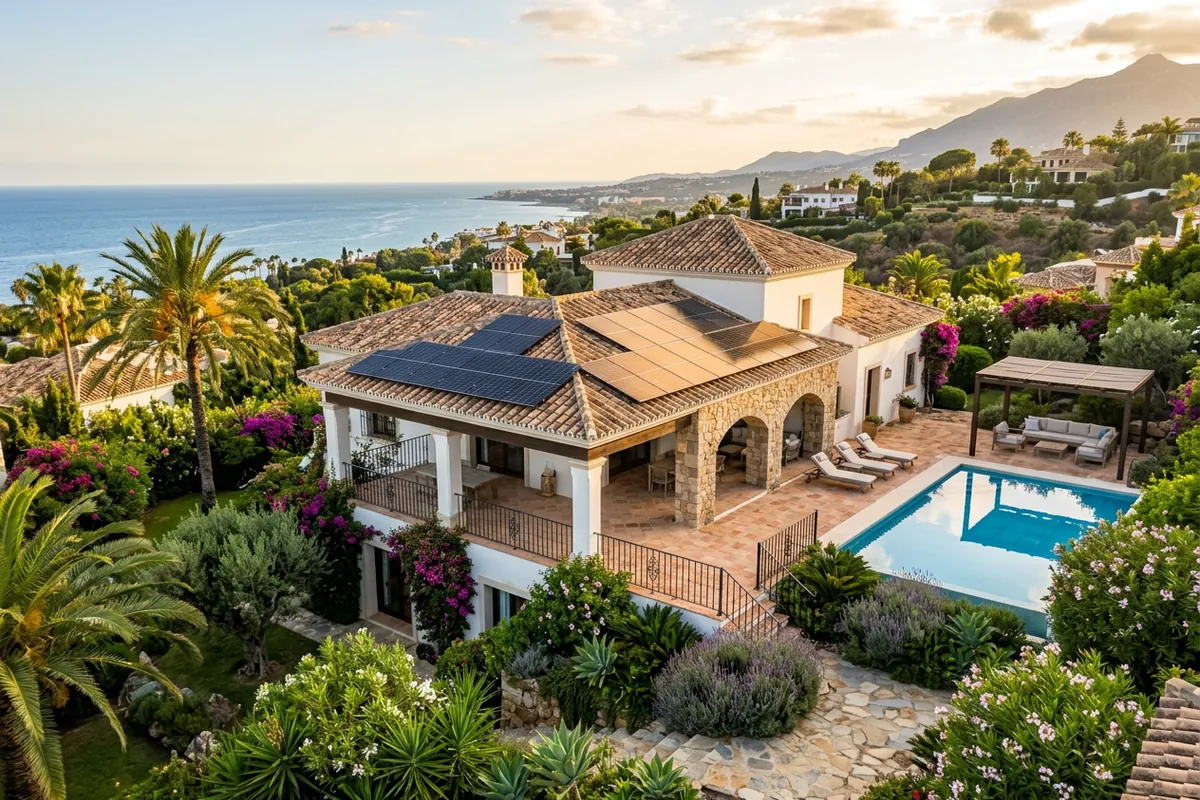
Solar PV panels capture the abundant Andalusian sunshine and convert it directly into electricity. In Marbella, where the midday UV index peaks at an intense 9 to 11 between June and August, your roof is a highly productive power plant. Modern tier-one monocrystalline panels are incredibly efficient, generating clean electricity that can power your home’s appliances, pool pumps, and lighting in real-time. Any excess energy can be stored in lithium-ion batteries for night-time use or fed back into the Endesa grid for a credit (compensación de excedentes).
Aerotermia (Air-Source Heat Pumps)
Aerotermia is a highly efficient thermodynamic system. It extracts up to 75% of its energy from the ambient outdoor air—even when it feels cold outside—to heat or cool water. This water is then circulated through your underfloor heating pipes, fan-coil air conditioning units, and domestic hot water tanks. It can also be diverted to heat your swimming pool during the shoulder seasons of spring and autumn.
The Synergy
On its own, aerotermia is highly efficient, delivering up to 4 kW of thermal energy for every 1 kW of electricity it consumes. However, when you couple aerotermia with a solar PV system, the electricity required to run the heat pump is generated entirely for free by your solar panels.
In a luxury Marbella villa, this synergy is a game-changer. During the hottest summer days, your solar panels are operating at peak production exactly when your aerotermia system needs maximum electricity to run the air conditioning. In the winter, the solar panels provide the baseline power needed to keep your underfloor heating running at a low, consistent temperature, eliminating the massive electricity bills that historically plagued winter residents.
Marbella’s Microclimate: Engineering for Salitre, Wind, and High UV
Designing a solar and aerotermia system in Marbella requires deep local knowledge of our unique coastal geography. Nestled between the towering La Concha peak (part of the Sierra Blanca massif and the foothills of the Sierra de las Nieves National Park) and 27 kilometers of Mediterranean coastline, Marbella’s microclimate presents specific environmental challenges that off-the-shelf systems cannot handle.
1. The Battle Against Salitre (Salt Mist)
If your property is located on the coastal strip—such as the Golden Mile corridor, Puerto Banús, or the beachside urbanizations of Elviria and San Pedro de Alcántara—your equipment will be constantly exposed to salitre (high salt-air salinity). Salt is highly corrosive to metals and electrical connections.
- For Solar PV: We only specify panels with certified salt-mist corrosion resistance (IEC 61701). Mounting structures must be marine-grade anodized aluminum or stainless steel (A4/316 grade). Using cheap galvanized steel brackets is a recipe for rust streaks on your roof within two seasons.
- For Aerotermia: The outdoor heat pump unit contains a condenser coil that is highly vulnerable to salt air. We ensure the outdoor units feature specialized anti-corrosion coatings (such as GoldFin or BlueFin technology) to prevent the aluminum fins from disintegrating.
2. Wind Loads: Poniente and Levante
Marbella is subject to strong prevailing sea breezes: the cool, damp Poniente from the west and the warm, humid Levante from the east. When installing solar panels on flat roofs (common in modern Sierra Blanca and Nueva Andalucía villas), they must be mounted on aerodynamic, ballast-secured structures or securely anchored to the roof slab. Proper wind-load calculations are essential to prevent the panels from acting as sails during winter storms.
3. High UV Degradation
With a midday summer UV index reaching 9 to 11, UV degradation is a major concern in Marbella. It doesn't just fade outdoor fabrics and dry out decking; it also degrades cheap plastics and exposed cabling. All solar cabling must be UV-resistant, double-insulated, and routed through protective, weather-proof conduits to prevent cracking and short circuits over time.
Navigating Marbella’s Complex Planning and Legal Landscape
Before you sign a contract for a solar or aerotermia installation, you must navigate Marbella’s notoriously complex planning environment. As a property manager, this is where I spend a significant amount of my time, ensuring our clients remain fully compliant with local laws.
The 1986 PGOU and Legal Uncertainty
The planning status of many plots in Marbella remains legally complex. The 2010 PGOU (General Plan) was annulled by the Spanish Supreme Court in a landmark ruling on October 27, 2015. This decision instantly restored the outdated 1986 PGOU as the governing urban plan. While a new PGOM (Plan General de Ordenación Municipal) received a favorable report from the Junta de Andalucía in February 2026 and awaits final plenary approval, the planning status of approximately 18,000 properties remains legally uncertain.
Before mounting solar panels on a roof, building an outdoor enclosure for an aerotermia unit, or installing a pergola to support solar panels, your technical team must verify the property’s legal status against the 1986 PGOU and any specific protected-zone overlays (such as those in parts of Las Chapas or Sierra Blanca).
Permits: Declaración Responsable vs. Obra Mayor
For standard solar PV installations on an existing, legal roof, the process has become much simpler in recent years. Under Andalusian regional law, these can usually be processed via a declaración responsable (responsible declaration) with the Ayuntamiento de Marbella, allowing works to begin shortly after submission.
However, there are critical exceptions:
- No Volume Expansion: Marbella ordinances strictly exclude any volume expansion or structural modifications from the fast-track declaración responsable process. If you need to build a new technical room to house your aerotermia tanks, or if you plan to install a large solar pergola, this will require a full municipal building license (obra mayor), which involves a longer approval timeline.
- Ley de Costas: If your villa is located on the frontline of the beach (for example, in Los Monteros or Marbesa), it may fall within the servidumbre de protección (the 20 to 100-meter protection zone from the maritime-terrestrial public domain). Any external modifications here require explicit authorization from the coastal authority (Delegación de Costas) before the town hall can issue any permits.
Community of Owners (Ley de Propiedad Horizontal)
If your property is an apartment or a townhouse within a community (common in areas like Los Naranjos, Aloha, or Elviria), you are bound by the Ley de Propiedad Horizontal.
- Common Elements: Any installation that alters common elements—such as placing solar panels on a communal roof or running aerotermia pipes down a shared façade—requires formal approval from the Community of Owners. Under Spanish law, changes to common elements typically require a 3/5 qualified majority vote at an annual or extraordinary general meeting.
- Aesthetics: Even in detached villa communities, there may be strict internal bylaws regarding the visibility of solar panels or outdoor heat pumps from the street or neighboring golf courses. We always advise presenting the technical project to the community president or administrator before commencing work.
Practical Implementation: Timelines, Logistics, and Property Management
When coordinating an installation for an international client—who is often away from Marbella for months at a time—flawless execution is essential.
The Expat Profile and Turnkey Expectations
Marbella’s premium, villa-led luxury market is driven by high-net-worth international buyers. Our community is beautifully diverse: the municipal padrón (as of December 31, 2024) records a population of 166,999, with approximately 33% being foreign-born (52,173 residents representing 153 registered nationalities). While British owners remain a long-dominant force, we manage properties for Scandinavian, German, Belgian, Dutch, Russian, Ukrainian, Colombian, and Moroccan families.
These international owners expect a seamless, turnkey experience. They do not want to manage multiple contractors or deal with local bureaucracy. When we coordinate a solar or aerotermia project, we handle everything:
- The Technical Audit: Assessing the villa’s current electrical installation, roof orientation, and thermal insulation.
- The Legal Check: Verifying the property's standing with the 1986 PGOU and submitting the necessary paperwork to the Ayuntamiento.
- The Installation Phase: Coordinating the physical installation, which typically takes 3 to 5 days for solar PV and 5 to 10 days for a complete aerotermia retrofitting, depending on the complexity of the existing plumbing.
- Grid Connection and Compensation: Registering the solar system with the industry department (Delegación de Industria) and negotiating the surplus energy compensation contract with the electricity provider.
Local Maintenance Considerations
Living in paradise comes with a few specific maintenance tasks that must be factored into your system's design:
- Bird-Proofing: Marbella’s coastal location means seagulls and pigeons are highly active. They love to nest warm under solar panels. We always install specialized stainless-steel bird mesh around the perimeter of the solar array to prevent nesting and protect the wiring.
- Dust and Calima: Occasionally, winds from the south bring calima (Sahara dust storms) to the Costa del Sol. This red dust coats solar panels, drastically reducing their efficiency. We recommend installing a dedicated rooftop water outlet so your property management team can easily rinse the panels down after a calima event.
- Pest Control: During the spring, the processionary caterpillar (procesionaria) season affects properties near pine trees (common in Elviria and Nagüeles). While they don't impact solar panels, they are a hazard for outdoor maintenance crews. Additionally, any outdoor wooden structures built to shade aerotermia units must be treated against termites, which are active in the region.
Financial Reality: What to Expect
While I do not quote fixed prices—as every luxury villa in Marbella has unique architectural demands, roof structures, and energy profiles—it is helpful to understand the general investment scale and returns for premium installations.
For a medium-to-large detached villa in Nueva Andalucía or Sierra Blanca:
- Solar PV Systems: A high-quality, corrosion-resistant 10 kW to 15 kW system (utilizing premium panels, microinverters or optimizers, and robust mounting structures) typically represents a mid-range five-figure investment. Adding high-capacity lithium battery storage will increase this initial outlay but allows the home to run almost entirely off-grid during summer nights.
- Aerotermia Systems: Retrofitting a large villa’s heating, cooling, and hot water systems to aerotermia involves replacing old boilers, installing buffer tanks, and integrating the heat pump with existing underfloor heating manifolds. This is a highly specialized engineering project that varies widely based on the home's scale.
- Return on Investment (ROI): With Marbella’s high electricity tariffs and the sheer volume of energy required to cool and heat these estates, most of our clients see a full return on their investment within 5 to 7 years. Furthermore, under current Spanish tax regulations, energy-efficiency improvements that significantly reduce non-renewable primary energy consumption can qualify for substantial personal income tax (IRPF) deductions.
By investing in a professionally engineered, legally compliant solar and aerotermia system, you protect your Marbella home against rising energy costs, safeguard it against the harsh coastal elements, and ensure it remains a sustainable, high-value asset for decades to come.
Frequently Asked Questions
How much does Solar Panel Installation in Marbella cost? ▼
The typical fee for Solar Panel Installation in Marbella is EUR 5,000–15,000 for residential system. We provide a transparent quote before any commitment.
Do you cover Marbella and surrounding areas? ▼
Yes, we connect you with vetted professionals covering Marbella and all nearby towns including San Pedro de Alcántara, Nueva Andalucía, Estepona.
How long does Solar Panel Installation take? ▼
Processing times vary, but most Solar Panel Installation cases in the Marbella area are completed within 2-8 weeks depending on complexity.
Other Home Services in Marbella
Property Management in Marbella
Already own a property? We manage holiday rentals, long-term lets, and keyholding.
View Property Management in Marbella →Also Serving Nearby
Get Your Free Property Assessment
Tell us your name and how to reach you. We respond within 2 hours.
or message us directly
WhatsApp Us Now