Window & Glazing Installation in Estepona
Professional window and glazing installation for Costa del Sol properties.
The Reality of Glazing and Window Replacement in Estepona: A Broker’s Field Guide
If you own a property in Estepona, you already know how privileged we are to live in this corner of the Costa del Sol Occidental. Stretching across 137 square kilometers with 23 kilometers of Mediterranean coastline, our municipality is uniquely sheltered. To the north, the majestic Sierra Bermeja rises to 1,449 meters at the Los Reales peak, acting as a natural shield that blocks cold northern winds. This mountain range, famous for its rare pinsapo fir forests, creates a highly localized microclimate boasting over 320 days of sunshine a year.
However, this beautiful geography presents unique challenges for home maintenance. The very elements that draw us here—the intense Mediterranean sun, the damp sea air, and the shifting winds—are incredibly harsh on residential infrastructure.
As a bilingual broker coordinating home maintenance and renovation services for international property owners across Estepona, I have managed countless window glazing and aluminium replacement projects. Whether you own a luxury villa in Los Flamingos Golf (near the Villa Padierna), a frontline apartment in Costalita or Bahía Dorada, or a family home in El Paraíso, Cancelada, or Atalaya, understanding the local technical, environmental, and administrative realities of window replacement is essential for protecting your investment.
The Estepona Climate: Why Standard Glazing Fails Here
Many of my international clients—particularly from the United Kingdom (our largest foreign community with around 4,615 registered residents), Germany, the Netherlands, and Scandinavia—are surprised by how quickly standard northern-European glazing specifications fail on our coast.
Estepona's climate is defined by two dominant winds: the dry, hot Poniente from the west, and the humid, moisture-laden Levante from the east. When the Levante blows, it traps a crown of clouds against Sierra Bermeja, spiking relative humidity levels. Conversely, our summers regularly climb to 30°C and above, delivering an intense UV index of 9 to 10+ during July and August. Across our 2,900 annual hours of sunshine, this relentless solar radiation punishes exterior materials.
If your property is located in coastal urbanizations like Saladillo-Benamara, Playa del Sol-Villacana, El Velerín, or Bahía Dorada, your windows face another silent enemy: salitre (high marine salinity).
- The Salt Air Problem: Standard anodized aluminium or low-grade PVC frames pit, corrode, and blister within a few seasons when exposed to the salt spray of the frontline beach.
- The Solar Heat Gain Problem: Large glass panes without proper solar-control treatment turn beautiful open-plan living rooms on the New Golden Mile into greenhouses. Your air conditioning units will run constantly, driving up electricity bills.
- The Condensation and Wind Load Problem: During winter, when we receive the bulk of our 600 mm of annual rainfall, the temperature differential between the humid sea air and your heated interior causes severe condensation on single-glazed or poorly insulated frames, leading to interior mold.
Selecting the Right Materials: Aluminium vs. PVC on the Coast
For premium villas in areas like Benavista, Bel-Air, El Presidente, and Atalaya Golf, the choice of framing material is critical.
1. Aluminium with Thermal Break (Rotura de Puente Térmico - RPT)
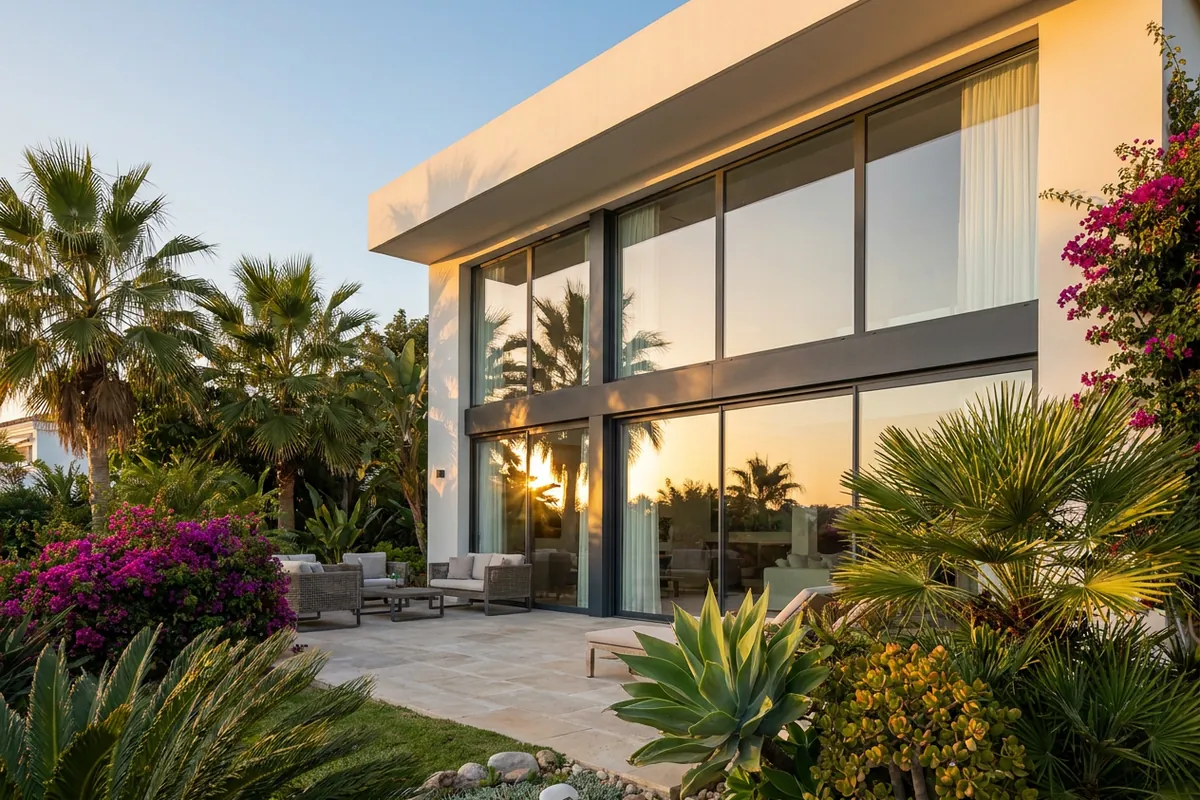
In Estepona, high-grade aluminium is the gold standard, particularly for the expansive, minimalist sliding doors favored in modern New Golden Mile architecture.
- Why it works: Aluminium is structurally rigid, allowing for ultra-slim profiles and massive glass spans that maximize sea views. To prevent heat transfer, you must specify frames with a Rotura de Puente Térmico (a polyamide insulating strip inside the frame).
- The Coastal Requirement: For any property within 150 meters of the high-tide line (such as Costalita or beachfront complexes along the Guadalmansa and Guadalobón rivers), the aluminium must carry the Qualanod (for anodized finishes) or Qualicoat Seaside (for powder-coated finishes) certification. This guarantees the metal has undergone pre-treatment to resist filiform corrosion caused by salitre.
2. High-Performance PVC
PVC is an exceptional thermal insulator and is highly resistant to salt air corrosion without needing specialized coatings.
- Why it works: It is highly effective at dampening acoustic noise—essential if your property sits near the A-7 coastal highway in areas like Selwo or El Padrón.
- The Coastal Limitation: PVC expands and contracts more than aluminium under high UV exposure. In dark colors (anthracite grey is highly popular in modern Andalusian designs), cheap PVC profiles can warp over time under Estepona’s summer heat. If choosing PVC, stick to premium multi-chambered profiles with galvanized steel reinforcements inside.
Glass Specifications: More Than Just Double Glazing
Simply asking a local installer for "double glazing" (known locally as doble acristalamiento or often referred to by the brand name Climalit) is not enough. To make your Estepona home comfortable year-round, your glass sandwich should feature a specific combination of technologies:
- Solar Control Glass (Control Solar): This microscopic metal oxide coating reflects the sun’s infrared radiation while letting visible light pass through. It is vital for south- and west-facing facades in Estepona to block the intense summer heat.
- Low-Emissivity Glass (Bajo Emisivo): This keeps your interior heat from escaping during the cooler winter nights when the mountain air rolls down from Sierra Bermeja.
- Laminated Safety Glass (Cristal Laminado/Securit): Essential for large sliding doors, especially in tourist-licensed rental properties where guest safety is paramount. It also provides a significant barrier against break-ins.
- Argon Gas Fill: Opting for argon gas instead of dehydrated air inside the chamber significantly improves thermal efficiency.
Navigating Community Rules and Local Regulations
Replacing windows in Estepona is not just a technical task; it is a legal and administrative process. Our municipality has a total population of over 79,621 residents (according to the 2025 INE annual census), with more than 25% of registered residents being foreign nationals from over 120 countries. This diverse, premium market means local administrations and community boards are highly organized and strict.
Community of Owners (Comunidad de Propietarios)
Before you touch a single window, you must consult your community’s statutes (Estatutos de la Comunidad). Under Spanish law (Ley de Propiedad Horizontal), the exterior facade is a common element.
- Aesthetic Uniformity: You cannot change the exterior color of the frames, the profile width, or the tint of the glass without formal approval from the community.
- Glass Curtains (Cortinas de Cristal): Frameless glass curtains on terraces (highly popular in apartments in Bahía Dorada or Costalita) are often subject to specific community guidelines regarding whether they can be installed and how they must fold.
The Town Hall: Ayuntamiento de Estepona
The Ilmo. Ayuntamiento de la Villa de Estepona regulates all building works through its municipal planning guidelines (PGOU). The town hall distinguishes between major works (obra mayor) and minor works (obra menor).
- Oba Menor (Minor Works): Replacing existing windows with units of the same size, color, and style is treated as a minor work under a simplified procedure (declaración responsable or comunicación previa). For urban plots, once you submit your application, pay the municipal tax (usually around 2% to 4% of the construction budget), and present the basic documentation, you can typically proceed within 15 days if no municipal objections are raised.
- Obra Mayor (Major Works): If you plan to enlarge a window opening, create a new window in a load-bearing wall, or fully enclose a terrace (adding habitable volume to the property), you will require an Obra Mayor license. This requires a project signed by an architect registered with the college of architects (COA) and can take several months to clear municipal planning departments.
- Special Protections: If your property sits on the frontline beach, it is subject to the strict Ley de Costas (Coastal Law), which imposes protection zones (up to 100 meters, sometimes reduced to 20 meters in consolidated urban land) and transit easements (6 meters). Any structural modification here undergoes rigorous scrutiny. Conversely, properties bordering the protected natural area of Sierra Bermeja face strict environmental restrictions on non-urbanizable land.
The Practical Steps: From NIE to Installation
For our international clients—whether you are a British expat managing a cross-border estate, a German investor, or a Dutch family purchasing a holiday home—coordinating these works requires a clear roadmap.
- Verify Your Legal Standing: Ensure your NIE (tax identification number) is active and your property deeds are fully in order. If you are coordinating this from abroad, you can grant a power of attorney (poder notarial) to your gestor, lawyer, or trusted broker to sign municipal paperwork on your behalf.
- Request a Detailed Budget (Presupuesto): A professional glazing quote in Estepona should always break down the exact profile brand (e.g., Cortizo, Schüco, Technal), the glass composition (e.g., 4+4/16/6 Climalit Guardian Sun), the wind-load rating, and the specific installation method.
- The Installation Process: A standard villa window replacement typically takes 3 to 5 working days on-site. Professional installers must use high-quality polyurethane foam and premium neutral-cure silicone designed to withstand high UV exposure and maritime salinity without cracking.
- Waste Disposal: Ensure your contractor includes the removal and ecological disposal of your old frames and glass at an authorized municipal clean point (Punto Limpio de Estepona).
By investing in high-performance, marine-grade double glazing tailored to Estepona’s unique microclimate, you do more than just lower your energy bills and eliminate dampness. You protect your property’s structural integrity, secure its resale value in our highly competitive premium market, and ensure your home remains a comfortable sanctuary against the intense Mediterranean sun and the salty winds of the Costa del Sol.
Frequently Asked Questions
How much does Window & Glazing Installation in Estepona cost? ▼
The typical fee for Window & Glazing Installation in Estepona is EUR 3,000–15,000 full property. We provide a transparent quote before any commitment.
Do you cover Estepona and surrounding areas? ▼
Yes, we connect you with vetted professionals covering Estepona and all nearby towns including Marbella, San Pedro de Alcántara, Manilva.
How long does Window & Glazing Installation take? ▼
Processing times vary, but most Window & Glazing Installation cases in the Estepona area are completed within 2-8 weeks depending on complexity.
Other Home Services in Estepona
Property Management in Estepona
Already own a property? We manage holiday rentals, long-term lets, and keyholding.
View Property Management in Estepona →Also Serving Nearby
Get Your Free Property Assessment
Tell us your name and how to reach you. We respond within 2 hours.
or message us directly
WhatsApp Us Now