Garden & Landscape Maintenance in Estepona
Professional garden and landscape maintenance for Costa del Sol properties.
Navigating Garden and Landscaping Maintenance in Estepona: A Founder’s Guide for Villa and Community Owners
As the founder of costadelsolhabitat.com, I have spent years acting as the bilingual bridge between international property owners and the specialized local trade services required to keep premium Mediterranean estates in pristine condition. Over the years, I have coordinated everything from emergency plumbing to complete landscape redesigns. If there is one thing I have learned managing properties in the Comarca of the Costa del Sol Occidental, it is that a garden in Estepona is not just an aesthetic asset; it is an active, demanding ecosystem.
Estepona has evolved into one of the most sought-after premium real estate markets in southern Spain. According to the 2025 INE (Censo Anual de Población), the official population has climbed to 79,621 residents, while the municipal padrón previously hovered around 72,000 registered inhabitants representing roughly 120 nationalities. More than 25% to 30% of our registered residents are foreigners. British expats form the largest international collective with approximately 4,615 registered residents, followed closely by Moroccan, Russian (around 942), German (around 835), Dutch (around 586), and Argentine nationals.
This diverse, high-net-worth demographic—stretching across the New Golden Mile (Nueva Milla de Oro), El Paraíso, Cancelada, Atalaya / Atalaya Golf, Benavista, Bel-Air, Costalita, El Presidente, Los Flamingos Golf (home to the iconic Villa Padierna), Selwo, Saladillo-Benamara, and Bahía Dorada—demands world-class landscaping. However, managing a garden here involves navigating a unique microclimate, strict coastal regulations, and complex community rules.
The Estepona Microclimate: Sun, Wind, and Sierra Bermeja
To design and maintain a successful garden in Estepona, you must understand our unique geography. Our municipality spans 137 square kilometers with 23 kilometers of Mediterranean coastline. To the north, we are dominated by Sierra Bermeja and its highest peak, Los Reales (1,449 meters), which is the westernmost bastion of the Baetic Cordillera and a protected natural area home to the rare pinsapo (Spanish fir) forest.
This mountain range plays a vital role in our daily lives. Sierra Bermeja acts as a protective shield, blocking cold northern winds and creating a highly localized microclimate characterized by over 320 days of sunshine a year and approximately 2,900 hours of annual sunlight. However, this geography also dictates our weather patterns:
- The Winds (Levante and Poniente): The Poniente blows from the west, bringing clear, dry air. The Levante blows from the east, carrying moisture from the Mediterranean. As the damp Levante hits the steep slopes of Sierra Bermeja, it condenses, leaving a crown of clouds over the mountain while trapping high humidity along the coast.
- Intense UV Radiation: During July and August, the UV index regularly hits 9 to 10+. This intense solar radiation rapidly degrades outdoor fabrics, awnings, pergolas, and wooden decking.
- Salitre (Salt Spray): For frontline beach communities in Costalita, Bahía Dorada, or along the coastal strip of El Padrón and Playa del Sol-Villacana, the air is thick with corrosive salt spray. This limits your plant palette to salt-tolerant species and accelerates the oxidation of metal garden fixtures, gates, and outdoor lighting.
- Water Scarcity: With an average annual rainfall of around 600 mm—highly concentrated in the winter months—and prolonged summer droughts, water management is the single most critical factor in local landscaping.
Designing for the Microclimate: Plant Selection and Irrigation
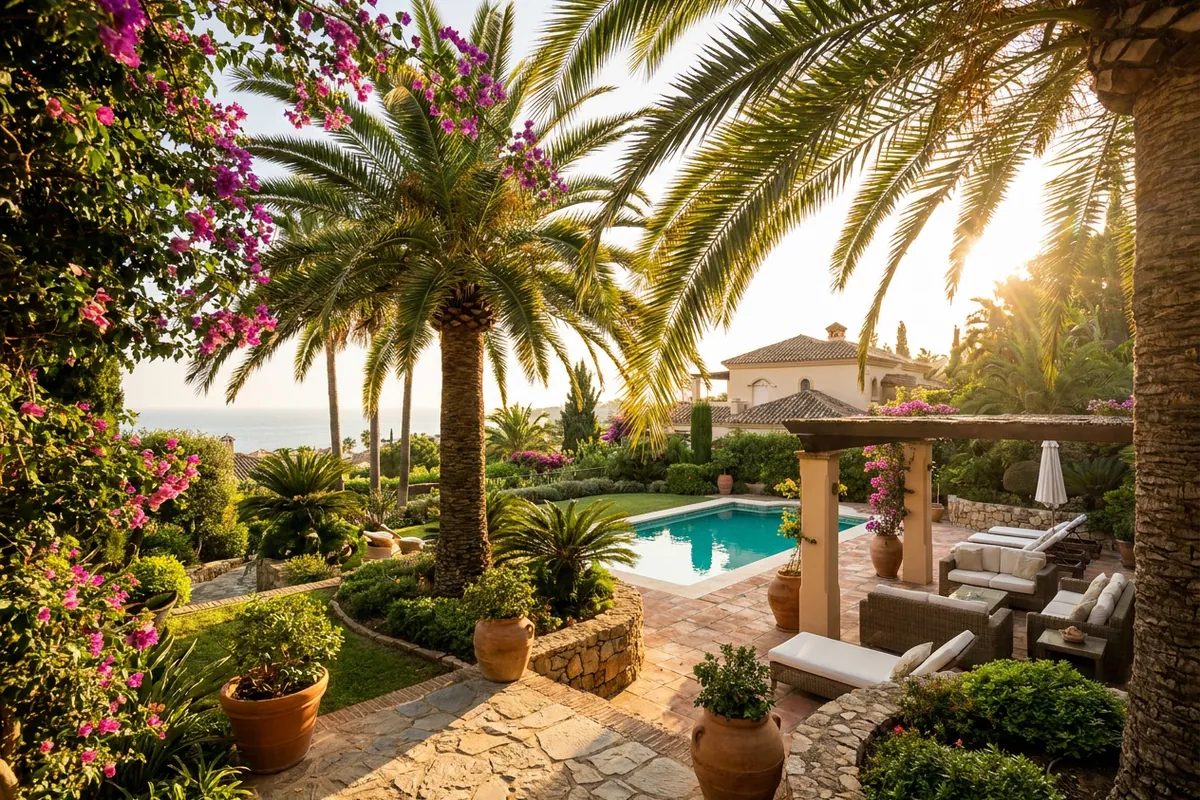
When advising international buyers on their villa gardens in El Paraíso, Bel-Air, or Los Flamingos, I always emphasize xeriscaping and climate-appropriate planting.
Salt and Wind-Tolerant Coastal Planting
If your property sits close to the shore, you need plants that can withstand both high salitre and the relentless Levante wind.
- Trees and Palms: Phoenix canariensis (Canary Island Date Palm), Washingtonia robusta, and Olive trees (Olea europaea) handle the salt wind beautifully.
- Shrubs and Groundcover: Nerium oleander (adelfa), Metrosideros, Bougainvillea, and Rosmarinus officinalis (rosemary) thrive in coastal soils.
- Avoid: Large-leafed tropical plants that tear in high winds or species susceptible to leaf-burn from salt spray.
Smart Irrigation and Water Conservation
With local reservoirs under constant pressure, relying on manual watering or outdated irrigation systems is a recipe for high water bills and municipal fines during drought cycles.
- Drip Irrigation: Essential for all flower beds and hedges. Subterranean drip lines reduce evaporation loss under the intense 30 C summer highs.
- Smart Controllers: We coordinate the installation of Wi-Fi-enabled irrigation controllers linked to local weather stations. If the Levante brings high humidity or a rare rain event occurs, the system automatically scales back.
- Lawn Alternatives: Traditional English lawns are unsustainable here. We assist clients in transitioning to drought-tolerant grass varieties like Zoysia japonica or Cynodon dactylon (Bermuda grass), or high-quality artificial turf, which has seen a massive surge in demand across modern villas on the New Golden Mile.
Local Pest Management: Processionaries, Termites, and Salitre
A beautiful garden requires vigilant pest control. In Estepona, three specific threats require professional, timely intervention.
1. Pine Processionary Caterpillars (Procesionaria del Pino)
If your villa in El Paraíso, Selwo, or Atalaya features pine trees (Pinus halepensis or Pinus pinea), you must monitor them closely between December and March. The caterpillars descend from their white, cotton-like nests in the pine branches to pupate in the soil, forming long, head-to-tail processions.
- The Danger: Their microscopic hairs carry a highly irritating toxin. For dogs and cats, touching or licking a caterpillar can lead to severe allergic reactions, tissue necrosis, and even death.
- The Solution: Professional arborists must spray the pines in autumn (October/November) or install physical collar traps around the trunks in winter to catch the caterpillars as they descend.
2. Termites and Wood-Boring Insects
The combination of high summer temperatures, winter humidity, and coastal moisture makes timber installations vulnerable. Pergolas, wooden decking, and structural beams must be treated annually with specialized insecticidal and fungicidal sealants to prevent subterranean termites and woodworm (carcoma) from compromising their structural integrity.
3. Bird-Proofing and Salt Protection
Coastal properties often struggle with seagulls and pigeons nesting on rooflines, solar panels, and pergolas. Installing discreet netting, spikes, or acoustic deterrents is essential to protect outdoor living spaces. Furthermore, all outdoor lighting, kitchen appliances, and metal structures must be made of marine-grade stainless steel (316) or powder-coated aluminum to resist the corrosive salitre.
Legalities, Permits, and Community Rules in Estepona
Altering your garden or outdoor living space is not as simple as hiring a contractor and digging. You must navigate three distinct layers of regulation: the Ayuntamiento de Estepona, the Spanish Ley de Costas, and your local Comunidad de Propietarios.
1. Municipal Permits (Ayuntamiento de Estepona)
The Ilmo. Ayuntamiento de la Villa de Estepona regulates all building and landscaping works through its Ordenanza Municipal Reguladora de Licencias. The ordinance distinguishes between:
- Obra Mayor (Major Works): Projects involving structural changes, alterations to the building volume, or those impacting protected areas (such as the northern non-urbanizable land near Sierra Bermeja). These require a full technical project signed by an architect and approved by the college of architects.
- Obra Menor (Minor Works): Simple technical works with a limited budget that do not alter the building's volume, structure, or exterior composition. Under the simplified procedure (declaración responsable or comunicación previa) for urban land, if the work does not affect the structure or increase volume, you can legally start work 15 days after submitting your application and paying the municipal fees, provided no clarification is requested by the town hall.
Note on Pergolas and Enclosures: Installing a simple, non-fixed wooden or aluminum pergola or an outdoor awning is typically processed as an obra menor. However, if you build a solid-roofed pergola that increases the built volume of the property, or if you install glass curtains (cortinas de cristal) to fully enclose a terrace, it may be classified as an obra mayor requiring a formal project and a longer approval timeline.
2. The Coastal Law (Ley de Costas)
If your property is located in a frontline urbanisation like Costalita, Bahía Dorada, or along the coastal strip of El Velerín, you must comply with the national Ley de Costas.
- Servidumbre de Protección (Protection Zone): This extends up to 100 meters inland from the maritime-terrestrial public domain (reducible to 20 meters in consolidated urban land designated before 1988). Within this zone, permanent construction is strictly restricted, and any significant landscaping or earthworks require authorization from the regional Andalusian coastal department.
- Servidumbre de Tránsito (Right-of-Way Zone): A 6-meter strip adjacent to the sea that must remain completely clear for pedestrian transit and rescue services. No permanent fences, walls, or heavy landscaping can block this zone.
3. Community of Owners (Comunidad de Propietarios)
If your villa or apartment is part of a community, the community statutes (Estatutos) govern what you can and cannot do to your exterior space. To maintain visual harmony, communities almost always require prior administrative approval for:
- Installing specific models or colors of awnings (toldos).
- Enclosing terraces with glass curtains.
- Altering perimeter fencing or changing the visible facade.
- Removing mature trees (which may also require a municipal permit from the town hall's environmental department).
The Practical Side: Timelines and Cost Expectations
To help you plan your landscaping and maintenance budget in the Estepona area, here is a realistic guide to current market timelines and cost ranges for professional services:
| Service Type | Estimated Timeline | Typical Cost Range (Indicative) |
|---|---|---|
| Routine Villa Garden Maintenance (Weekly/Fortnightly visits, lawn mowing, pruning, irrigation checks) | Ongoing contract | €150 - €500+ per month (depending on plot size, lawn area, and pool integration) |
| Processionary Caterpillar Treatment (Micro-injection or spraying of pine trees) | 1 - 2 days (Best done in Oct/Nov) | €120 - €300 per treatment (depending on the number and height of pines) |
| Minor Works Permit (Declaración Responsable) | 15-day waiting period after submission | Municipal tax typically 2% to 4% of the estimated construction budget (P.E.M.) |
| Installation of Artificial Turf (Excavation, drainage base, weed membrane, high-quality turf) | 3 - 7 days | €45 - €95 per square meter (installed) |
| Smart Irrigation Retrofitting (Controller, solenoid valves, drip lines for a medium villa) | 2 - 4 days | €800 - €2,500 (depending on zones and complexity) |
Cross-Border Estates: Managing Your Spanish Property Seamlessly
For our international clients—whether you are a British expat managing a family estate in El Paraíso, a Dutch investor with a luxury villa in Los Flamingos, or a German family enjoying a second home in Atalaya—navigating Spanish bureaucracy from abroad can be daunting.
When undertaking major landscaping or renovations, it is vital to secure your Spanish tax identification number (NIE), work with a registered local gestor or lawyer to handle town hall submissions, and ensure your property management team has a direct line of communication with your community administrator.
By coordinating these moving parts—microclimate-specific design, strict adherence to municipal and coastal laws, and proactive pest control—you protect your investment and ensure your Mediterranean garden remains a private paradise for years to come.
Frequently Asked Questions
How much does Garden & Landscape Maintenance in Estepona cost? ▼
The typical fee for Garden & Landscape Maintenance in Estepona is EUR 100–300/month. We provide a transparent quote before any commitment.
Do you cover Estepona and surrounding areas? ▼
Yes, we connect you with vetted professionals covering Estepona and all nearby towns including Marbella, San Pedro de Alcántara, Manilva.
How long does Garden & Landscape Maintenance take? ▼
Processing times vary, but most Garden & Landscape Maintenance cases in the Estepona area are completed within 2-8 weeks depending on complexity.
Other Home Services in Estepona
Property Management in Estepona
Already own a property? We manage holiday rentals, long-term lets, and keyholding.
View Property Management in Estepona →Also Serving Nearby
Get Your Free Property Assessment
Tell us your name and how to reach you. We respond within 2 hours.
or message us directly
WhatsApp Us Now