Tourist Rental License in San Pedro de Alcántara
Navigate Andalusia's tourist rental rules (VFT) with expert guidance.
Navigating the Holiday Rental Landscape in San Pedro de Alcántara
As the founder of costadelsolhabitat.com, I have spent years guiding international property owners through the administrative, legal, and operational realities of owning real estate in the Costa del Sol Occidental. Over this time, few areas have evolved as dynamically as San Pedro de Alcántara.
As the second-largest population center within the municipality of Marbella—which recorded 165,871 residents in 2024 and is projected to reach 173,420 by 2026—San Pedro itself is home to 40,012 inhabitants (according to the January 1, 2024, INE Padrón Municipal). It is a thriving coastal enclave that beautifully balances its traditional Andalusian "pueblo" character with a highly sophisticated, premium real estate market.
Unlike the high-volume, mass-tourism hubs elsewhere on the coast, San Pedro attracts a discerning, high-net-worth expat profile. Here, the foreign resident population mirrors Marbella’s municipal average, which has climbed from 24.58 percent in 2019 to nearly 30 percent in 2025-2026. This international community is led by citizens from the United Kingdom, Morocco, Ukraine, Russia, Italy, Germany, Colombia, and Romania.
Whether you own a frontline luxury villa in Guadalmina Baja valued between 1.5 and 6 million euros, a golf-side townhouse in Guadalmina Alta, or a modern apartment in Nueva Alcántara, Cortijo Blanco, Linda Vista, or Las Petunias, transforming your property into a compliant, high-yielding holiday let requires a deep understanding of local, regional, and national regulations.
Securing a tourist rental licence (Licencia de Vivienda de Fines Turísticos) and maintaining compliance with the Junta de Andalucía is not merely a matter of filling out a form online. It involves navigating Marbella’s specific urban planning laws, understanding coastal protections, respecting community of owners' rights, and managing the unique environmental challenges of our microclimate.
The Legal Framework: Registering Your Licencia Turística in San Pedro
To legally market and rent your property to tourists on a short-term basis (under 31 days per stay), you must register the property with the Registro de Turismo de Andalucía. This process is governed by Decree 31/2024, which introduced stricter standards for holiday rentals across the region.
Step 1: Verifying Urban Planning Compliance (The Marbella PGOU)
Before submitting your application to the Junta de Andalucía, you must ensure your property complies with local municipal planning. Because San Pedro de Alcántara is a district within the municipality of Marbella (managed by the Tenencia de Alcaldía de San Pedro Alcántara), all properties are subject to the urban planning rules of the Ayuntamiento de Marbella.
Following the judicial annulment of the 2010 PGOU, Marbella reverted to its 1986 General Plan (PGOU de 1986). This means we must verify the exact urban classification of your specific plot or building. The property must possess a valid Licencia de Primera Ocupación (LPO) or, in older properties where the LPO is unavailable, an equivalent municipal certificate (such as the AFO - Asimilado al Régimen de Fuera de Ordenación). Attempting to register a tourist licence without a valid LPO is the primary reason the Junta de Andalucía rejects or cancels registrations.
Step 2: The Community of Owners (Comunidad de Propietarios)
Under Spanish Horizontal Property Law (Ley de Propiedad Horizontal), communities of owners have the legal right to limit or ban holiday rentals within their complexes if three-fifths of the owners (representing three-fifths of the participation quotas) vote to do so. Before purchasing a property or applying for a licence in developments across Nueva Alcántara, Cortijo Blanco, or Guadalmina, we must thoroughly review the community statutes registered at the Land Registry (Registro de la Propiedad). If a ban is already active and registered, the Junta de Andalucía will deny your application.
Step 3: Submitting the Declaración Responsable
Once urban and community compliance are verified, we submit a Declaración Responsable de Inicio de Actividad (Responsible Declaration of Commencement of Activity) to the Delegación de Turismo.
This submission must be accompanied by:
- The catastral reference (Referencia Catastral) of the property.
- The details of the property owner and, if applicable, the designated property management agency or legal representative.
- Proof of the LPO or municipal equivalent.
- Confirmation that the property meets the minimum physical standards (air conditioning in all bedrooms and living areas if rented between May and September, heating if rented between October and April, adequate ventilation, first-aid kits, and official complaint forms/Hojas de Reclamaciones).
Upon successful submission, the Junta issues a registration number (e.g., VFT/MA/XXXXX or the newer VUT/MA/XXXXX). This code is your golden ticket: it must be displayed on every online listing, from Airbnb and Booking.com to private agency websites. Operating without this number, or displaying a false one, carries severe penalties that can reach tens of thousands of euros.
Local Geography, Coastal Protections, and the Ley de Costas
San Pedro de Alcántara boasts a unique geography. It is bordered to the west by Estepona and Benahavís, and to the east by Puerto Banús and Nueva Andalucía. The town is traversed by three rivers—the Guadalmina, the Guadaiza, and Río Verde—which flow from the Sierra Blanca and Sierra de las Nieves mountain ranges down to our 4.9-kilometer coastline.
This coastal strip, which has proudly held a Blue Flag rating since 1993 across the beaches of Guadalmina, Linda Vista, and San Pedro, is highly protected. Near the mouth of the Guadalmina River, you will also find the historic, highly protected 4th-century archaeological site of the Basílica Paleocristiana de Vega del Mar.
If your property is located in Guadalmina Baja, Linda Vista Playa, or along the frontline of San Pedro's beachside promenade, it is subject to the Spanish Coastal Law (Ley de Costas). This law establishes:
- A Protection Easement (Servidumbre de Protección): Typically 100 meters from the shoreline, which can be reduced to 20 meters in consolidated urban land.
- A Transit Easement (Servidumbre de Tránsito): A 6-meter strip adjacent to the public maritime-terrestrial domain that must remain completely unobstructed.
Any physical modifications, renovations, or installations (such as beach access paths, retaining walls, or outdoor structures) within these zones require express authorization from the Demarcación de Costas, in addition to municipal permits from the Marbella Town Hall. Furthermore, properties located near the riverbeds of the Guadalmina or Guadaiza may face strict building and rental restrictions due to flood-risk zoning (Dominio Público Hidráulico).
Property Modifications: Pérgolas, Glazing, and Marbella Permits
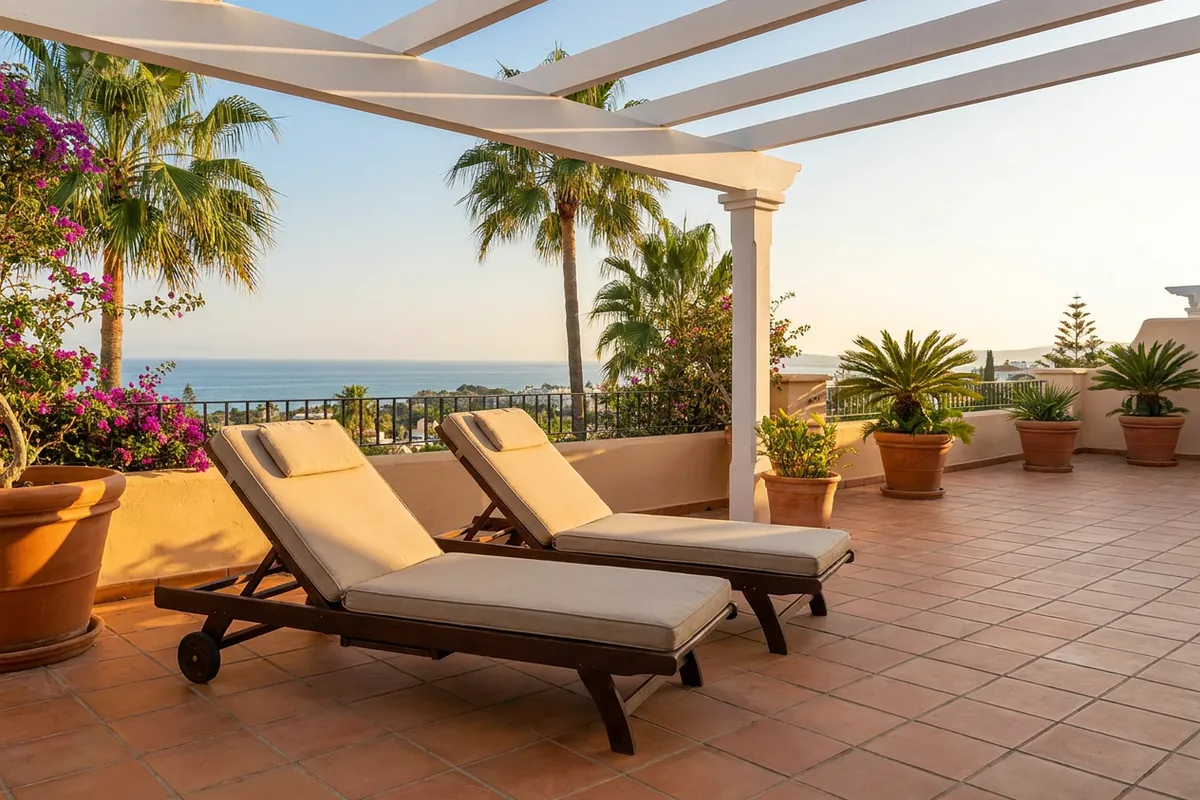
Many international owners wish to upgrade their properties to meet the high expectations of premium holidaymakers. In San Pedro, where we enjoy approximately 2,900 hours of sunshine per year and around 320 sunny days, outdoor living spaces are paramount. High-end outdoor installations like bioclimatic pérgolas, glass curtains (cortinas de cristal), outdoor kitchens, and artificial grass are highly sought after.
However, executing these modifications requires strict adherence to Andalusian planning laws (specifically the Ley 7/2021 LISTA) and Marbella's municipal ordinances:
- Pérgolas and Lightweight Structures: Under the LISTA framework, minor interventions can often be processed via a Declaración Responsable (Responsible Declaration) rather than a lengthy building licence. For pérgolas, structures under approximately 5 square meters are generally exempt from permits. Pérgolas between 5 and 20 square meters usually require a Declaración Responsable or a minor works permit (obra menor). Any structure exceeding 20 square meters is classified as a major work (obra mayor) and requires a formal technical project designed by an architect.
- Terrace Glazing (Cerramiento de Terrazas): The installation of glass curtains to enclose terraces is highly popular. However, because this can alter the external aesthetic of the building and potentially increase the enclosed volume of the property, it is excluded from simple declarations. It requires a formal municipal licence.
- Community Rules: Even if the Town Hall permits an installation, you must obtain written consent from your Community of Owners. Under the Horizontal Property Law, any modification affecting the facade, aesthetic uniformity, or common elements of the complex requires formal community approval.
Environmental and Maintenance Challenges: Protecting Your Investment
San Pedro’s microclimate is beautiful, but it presents specific environmental challenges that can rapidly degrade a property if left unmanaged. Our summer temperatures frequently hit highs of 30°C, and we experience an intense UV index of 9 to 10+ from June through August. This extreme solar exposure quickly degrades untreated awnings, composite decking, and outdoor fabrics.
Additionally, our coastal location means properties face high levels of salitre (salt spray). This airborne salt accelerates the corrosion of metal fixtures, outdoor kitchens, and air conditioning units. For holiday rentals, choosing marine-grade materials, powder-coated aluminum, and UV-stabilized composites is essential to prevent costly, mid-season breakdowns.
Beyond the climate, local property managers must handle specific biological and structural threats:
- Processionary Caterpillars (Procesionaria del Pino): Active from January to April, these caterpillars nest in pine trees (common in Guadalmina Alta and Baja). Their microscopic hairs are highly toxic to dogs and can cause severe allergic reactions in children. Annual preventive spraying of pine trees on your property is a legal and safety necessity for holiday lets.
- Termites and Wood-Boring Insects: The humid coastal air combined with older wooden structures in parts of El Ingenio, El Salto del Agua, or older Guadalmina villas makes regular termite inspections crucial.
- Bird-Proofing: Seagulls and pigeons frequently nest on flat roofs, solariums, and terraces, causing damage and hygiene issues. Professional bird-proofing (nets, spikes, or acoustic deterrents) is often required for penthouse apartments.
The Legal Journey for International Owners: NIE, Notaries, and Gestores
For foreign buyers—whether from the UK, Germany, or Scandinavia—navigating the administrative steps to buy, register, and rent out a property in San Pedro de Alcántara involves a structured, multi-step legal process.
[Apply for NIE Number]
       │
       ▼
[Open Spanish Bank Account]
       │
       ▼
[Draft & Sign Arras Agreement]
       │
       ▼
[Notary Signing (Escritura Pública)]
       │
       ▼
[Land Registry & Tax Payment]
       │
       ▼
[Apply for Licencia Turística]
- Obtaining the NIE (Número de Identidad de Extranjero): This is your personal Spanish tax identification number. It is mandatory for purchasing property, opening a bank account, and registering a tourist licence. It can be obtained via a Spanish consulate abroad or in person at a national police station in Spain (typically requiring an appointment booked weeks in advance).
- Appointing a Local Representative: We highly recommend appointing a local lawyer (abogado) or a registered administrative agent (gestor) via a Power of Attorney (Poder Notarial). This allows them to sign documents, pay taxes, and submit municipal applications on your behalf.
- The Notary (Notaría): The final purchase deed (Escritura Pública de Compraventa) must be signed before a Spanish Notary. In San Pedro and Marbella, notaries will verify the identities of the parties, check the land registry status, and ensure the transaction complies with Spanish anti-money laundering laws.
- Taxation and Cross-Border Estates: Non-resident owners must pay Non-Resident Income Tax (IRNR) on income generated from holiday rentals. For EU/EEA residents, the tax rate is 19% on net income (allowing for the deduction of property-related expenses). For non-EU residents (including UK owners post-Brexit), the rate is 24% on gross income, with no expense deductions allowed. Furthermore, setting up a cross-border estate plan (such as a Spanish will specifically covering your Andalusian assets) is highly recommended to protect your heirs from complex, multi-jurisdictional probate issues.
Timelines and Costs
While exact costs depend on the property's size and specific legal status, international owners should plan for the following standard municipal timelines and administrative cost ranges:
- NIE Application: 1 to 3 weeks; administrative fees under 20 euros (excluding legal representation).
- Licencia Turística Registration: Once the LPO is verified, the submission of the Declaración Responsable is instant, but the Junta de Andalucía's inspection and final registration code issuance typically takes between 2 to 6 weeks.
- Minor Works Permit (Obra Menor) for outdoor upgrades: 1 to 3 months depending on the Marbella Town Hall backlog; municipal taxes generally range between 3% and 4% of the estimated construction budget (Presupuesto de Ejecución Material).
- Major Works Licence (Obra Mayor): 6 to 12+ months; requiring architectural projects and municipal fees.
By understanding these local nuances, respecting the coastal and municipal planning frameworks, and preparing your property for the unique microclimate of San Pedro de Alcántara, you can ensure your holiday rental remains fully compliant, highly profitable, and a source of pride for years to come.
Frequently Asked Questions
How much does Tourist Rental License (VFT) in San Pedro de Alcántara cost? ▼
The typical fee for Tourist Rental License (VFT) in San Pedro de Alcántara is EUR 500–1,500 (application process). We provide a transparent quote before any commitment.
Do you cover San Pedro de Alcántara and surrounding areas? ▼
Yes, we connect you with vetted professionals covering San Pedro de Alcántara and all nearby towns including Marbella, Nueva Andalucía, Estepona.
How long does Tourist Rental License (VFT) take? ▼
Processing times vary, but most Tourist Rental License (VFT) cases in the San Pedro de Alcántara area are completed within 2-8 weeks depending on complexity.
Other Legal Services in San Pedro de Alcántara
Property Management in San Pedro de Alcántara
Already own a property? We manage holiday rentals, long-term lets, and keyholding.
View Property Management in San Pedro de Alcántara →Home Services in San Pedro de Alcántara
Also Serving Nearby
Get Your Free Property Assessment
Tell us your name and how to reach you. We respond within 2 hours.
or message us directly
WhatsApp Us Now