Digital Nomad Visa Spain in Estepona
Spain's digital nomad visa lets remote workers live and work legally on the Costa del Sol.
Navigating the Estepona Digital Nomad Visa and Residency-by-Work: A Local Broker’s Guide
As the founder of costadelsolhabitat.com, I have spent years coordinating legal, administrative, and real estate services for international property owners across the Costa del Sol Occidental. Over the last decade, I have watched Estepona transform. Once a quiet fishing town, it has evolved into one of the most sought-after premium destinations in southern Spain.
Today, Estepona is a thriving, cosmopolitan hub. According to the 2025 INE (Censo Anual de Población), the municipal population has surged past 79,621 inhabitants. The local municipal register (el padrón) previously hovered around 72,000, representing over 120 different nationalities. Our local foreign resident population is exceptionally strong, making up between 25% and 30% of the registered community. British nationals form the largest foreign collective with approximately 4,615 registered residents, closely followed by Moroccan, Russian (around 942), German (around 835), Dutch (around 586), and Argentine communities.
This international mosaic, combined with our unique microclimate—boasting over 320 days of sunshine a year, roughly 2,900 sun hours annually, and only about 600 mm of rain—makes Estepona an absolute paradise for remote workers. Sheltered from the cold northern winds by the striking red-stone Sierra Bermeja (culminating in the Los Reales peak at 1,449 meters), the coast enjoys mild winters and summer highs that hover around 30°C. However, moving your life and your business to this corner of the Costa del Sol Occidental requires navigating a complex web of Spanish immigration law, local municipal regulations, and cross-border tax considerations.
Whether you are eyeing a luxury villa in the New Golden Mile, El Paraíso, or Los Flamingos Golf, or a beachfront apartment in Costalita or Bahía Dorada, here is the practical, boots-on-the-ground reality of securing your Spanish Digital Nomad Visa (DNV) and establishing your life in Estepona.
The Digital Nomad Visa: Spain’s Gateway for Remote Workers
Introduced under the Spanish Startup Act, the Digital Nomad Visa (Residencia para Teletrabajadores de Carácter Internacional) has revolutionized how non-EU citizens live and work in Spain. It allows self-employed freelancers or remote employees of non-Spanish companies to legally reside here while enjoying our Mediterranean lifestyle.
To qualify, you must meet several strict federal criteria, which we regularly help clients prepare for before they present their files to the Spanish Consulates abroad or directly to the U.S.G.E. (Unidad de Grandes Empresas) in Spain:
- Employment Relationship: You must prove you have worked for your non-Spanish employers or clients for at least three months prior to your application. The companies you work for must have been active for at least one year.
- Income Thresholds: You must demonstrate financial self-sufficiency. This is tied to the Spanish Minimum Wage (SMI). Typically, the main applicant must prove a monthly income equivalent to 200% of the SMI, with additional percentages required for spouses (75%) and children (25% per dependent).
- Academic or Professional Standing: You must hold a degree from a prestigious university or business school, or prove at least three years of professional experience in your sector.
- Clean Criminal Record: You must provide apostilled and translated criminal record certificates from any country you have resided in during the last two to five years.
- Private Health Insurance: You must secure a comprehensive private health policy with a Spanish insurer, offering full coverage without copayments or waiting periods.
The Local Legal and Administrative Steps in Estepona
While the visa approval itself is handled at the state level, your day-to-day legal integration happens right here in Estepona. This is where many remote workers hit administrative bottlenecks. To transition smoothly, you must navigate several local steps:
- Securing your NIE (Número de Identidad de Extranjero): This is your tax identification number. You cannot rent a long-term property, buy a home, set up utilities, or hire a local gestor without it. We coordinate appointments at the National Police Station (Comisaría de Policía Nacional de Estepona) or help you obtain it via a Spanish consulate abroad.
- The El Padrón Registration: Once you have a rental contract (of at least 11–12 months) or purchase deeds for a property in areas like Cancelada, Atalaya, or Benavista, you must register on the municipal census at the Ilmo. Ayuntamiento de la Villa de Estepona. This certificado de empadronamiento is a mandatory document when you apply for your physical residency card (TIE) at the police station.
- Cross-Border Tax Planning: Moving to Estepona on a Digital Nomad Visa has major tax implications. Spain offers a special tax regime (often referred to as the modified "Beckham Law") for digital nomads, allowing qualifying individuals to be taxed at a flat rate of 24% on income up to €600,000, rather than progressive rates. Because we deal with a high-net-worth expat profile—particularly across the premium villa markets of Los Flamingos, El Paraíso, and Selwo—we coordinate with cross-border tax specialists who specialize in UK-ES, DE-ES, and US-ES double taxation treaties to ensure you do not get double-taxed on your global income.
Real Estate Realities: Finding Your Workspace in Estepona
Estepona's property market is highly segmented. The New Golden Mile, El Paraíso, Atalaya, and the areas surrounding Villa Padierna (Los Flamingos Golf) concentrate high-end, luxury new-build developments and sprawling villas. If you prefer coastal apartment living, frontline complexes in Costalita, Saladillo-Benamara, and Bahía Dorada offer direct beach access.
When choosing a property to serve as your home office, you must look beyond the aesthetic views of Sierra Bermeja and consider the practicalities of Spanish property law and coastal geography.
High Salitre and the Microclimate Challenge
Estepona’s coastal strip experiences high levels of salitre (sea salt residue) carried by the prevailing Levante (easterly) and Poniente (westerly) winds. The Levante wind often leaves a characteristic crown of clouds over Sierra Bermeja, while the mountain itself shields the coast from freezing northern winds.
This microclimate is wonderful for your health, but the intense UV radiation (with indices reaching 9 to 10+ in July and August) and sea salt will aggressively punish outdoor furniture, wooden pergolas, awnings, and exterior textiles. If you are setting up an outdoor terrace workspace in frontline communities like Costalita or Bahía Dorada, expect high maintenance costs and ensure all exterior materials are marine-grade.
Navigating the Ayuntamiento and Community Rules
If you buy a villa or apartment and plan to modify it to create the perfect home office—such as enclosing a terrace with glass curtains, installing pergolas, or adding outdoor office pods—you must comply with both local municipal ordinances and your community of owners (comunidad de propietarios).
- The Ayuntamiento Permitting Process: The Ayuntamiento de Estepona operates under a municipal licensing ordinance (Ordenanza Municipal Reguladora de Licencias) that distinguishes between obra mayor (major works involving structural changes, volume increases, or significant budgets) and obra menor (minor works of simple technique and limited budget). For a simplified obra menor on urban land—such as minor interior renovations that do not alter the building's structure or volume—you can submit a declaración responsable (responsible declaration) or comunicación previa and legally begin work within 15 days if no municipal objections are raised. However, installing pergolas, awnings, or enclosing terraces can be classified as obra mayor if they alter the building's exterior volume or facade. Always consult the current PGOU (General Plan) via the Ayuntamiento's electronic urban planning portal.
- The Ley de Costas (Coastal Law): If your property is on the frontline (e.g., Bahía Dorada or Playa del Sol-Villacana), it is subject to the strict federal Ley de Costas. This law imposes a protection easement (servidumbre de protección) of up to 100 meters (which can be reduced to 20 meters in consolidated urban zones) and a transit easement (servidumbre de tránsito) of 6 meters. Permanent structural additions within these zones are heavily restricted or outright prohibited.
- Community Statutes: Even if the Ayuntamiento permits a modification, the statutes of your local comunidad de propietarios almost always require formal approval for glass curtains, terrace enclosures, or specific awning colors to preserve the aesthetic harmony of the urbanization.
Local Property and Administrative Pitfalls to Avoid
Relocating to Estepona as a remote worker involves managing several hyper-local environmental and administrative challenges that foreign buyers rarely anticipate:
1. The Processionary Caterpillar Season
If you choose a villa with a garden in pine-heavy areas like El Padrón, Selwo, or the pine forests of Roche/El Paraíso, you must protect your household from the Pine Processionary Caterpillar (procesionaria del pino). From January to April, these caterpillars descend from their silk nests in the pine trees. Their microscopic hairs carry an irritating protein that is highly toxic—and potentially fatal—to dogs and can cause severe allergic reactions in humans. Annual preventative micro-injection treatments for your pine trees are essential.
2. Termites and Bird-Proofing
The warm, humid climate of the Costa del Sol Occidental is highly conducive to subterranean termites, which can silently destroy wooden pergolas, window frames, and structural beams. Regular pest inspections are a must. Additionally, coastal properties frequently require professional bird-proofing (such as netting or spikes) to prevent seagulls and pigeons from nesting on roof terraces and damaging outdoor workspace setups.
3. Tourist Licenses vs. Long-Term Rentals
If you plan to travel frequently and want to rent out your Estepona property while you are away, you must obtain a tourist license (licencia de primera ocupación and registration with the Registro de Turismo de Andalucía). Many communities of owners in Estepona have voted to restrict or ban short-term holiday rentals within their complexes. We review the community statutes (estatutos de la comunidad) before you purchase to ensure your investment matches your lifestyle plans.
Setting Up Your Life in Estepona: A Trusted Partnership
Relocating under the Digital Nomad Visa is more than just a paperwork exercise; it is the beginning of a new chapter. At costadelsolhabitat.com, we act as your local boots on the ground. We bridge the gap between international expectations and Spanish administrative realities, coordinating with trusted local gestores, bilingual lawyers, and municipal technicians.
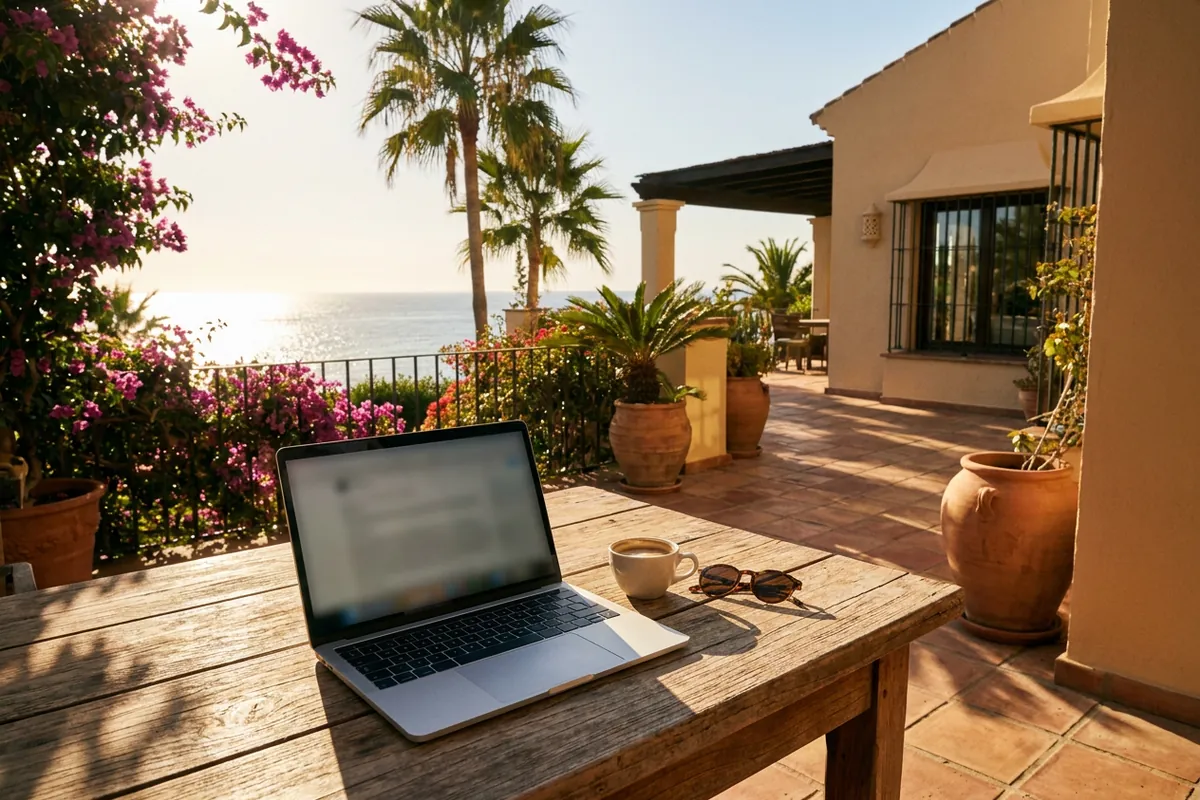
From securing your initial NIE and navigating the padrón at the Estepona Ayuntamiento, to analyzing the PGOU and Ley de Costas restrictions on your dream coastal property, we ensure your transition to the Costa del Sol Occidental is legally secure and stress-free. Let us handle the bureaucracy, so you can focus on enjoying your new remote office under the warm Estepona sun.
Frequently Asked Questions
How much does Digital Nomad Visa Spain in Estepona cost? ▼
The typical fee for Digital Nomad Visa Spain in Estepona is EUR 500–1,000 (lawyer fee). We provide a transparent quote before any commitment.
Do you cover Estepona and surrounding areas? ▼
Yes, we connect you with vetted professionals covering Estepona and all nearby towns including Marbella, San Pedro de Alcántara, Manilva.
How long does Digital Nomad Visa Spain take? ▼
Processing times vary, but most Digital Nomad Visa Spain cases in the Estepona area are completed within 2-8 weeks depending on complexity.
Other Legal Services in Estepona
Property Management in Estepona
Already own a property? We manage holiday rentals, long-term lets, and keyholding.
View Property Management in Estepona →Home Services in Estepona
Also Serving Nearby
Get Your Free Property Assessment
Tell us your name and how to reach you. We respond within 2 hours.
or message us directly
WhatsApp Us Now