Solar Panel Installation in Sotogrande
Professional solar panel installation for Costa del Sol properties.
The Sotogrande Energy Transition: Solar PV and Aerotermia for Premium Coastal Villas
As the founder of costadelsolhabitat.com, I have spent years coordinating bespoke property management and home maintenance services for international owners across the western Costa del Sol. While our agency's name reflects the wider coastal region, our daily operations frequently take us into the ultra-exclusive enclave of Sotogrande.
Sotogrande is a unique geographical and administrative entity. Located in the Campo de Gibraltar comarca, it sits within the province of Cádiz, not Málaga, approximately 15 kilometers from Gibraltar and 25 kilometers west of the Estepona border. This distinction is critical for property owners to understand, as all municipal planning, tax incentives, and building permits are governed by the Ilustre Ayuntamiento de San Roque, rather than the Málaga-based authorities.
Managing a villa in Sotogrande—whether a classic estate on the tree-lined avenues of Kings & Queens (Paseo del Parque) in Sotogrande Costa, a modern architectural masterpiece in La Reserva de Sotogrande, or a luxury penthouse overlooking the yachts in Ribera del Marlin—presents distinct environmental and administrative challenges.
With over 2,850 hours of sunshine per year and a high summer UV index (frequently reaching 9 to 10 between June and August), Sotogrande is prime territory for solar photovoltaic (PV) systems. When paired with aerotermia (air-to-water heat pump technology), international owners can slash their running costs by up to 70% to 80%. However, executing these installations in Europe’s premier low-density residential resort requires navigating specific microclimates, strict community aesthetic guidelines, and complex municipal licensing.
The Sotogrande Microclimate: Why Premium Specifications Matter
Sotogrande’s position at the mouth of the Río Guadiaro, right where the Mediterranean meets the Strait of Gibraltar, subjects it to a highly specific microclimate. Unlike the sheltered bays of Marbella or Estepona, Sotogrande is heavily influenced by the alternating wind patterns of the Strait: the damp, easterly Levante and the dry, westerly Poniente.
The Levante, in particular, blows with significant force and frequency. This strong wind carries high levels of salitre (salt-laden sea spray) directly off the sea.
- Sotogrande Costa, Kings & Queens, and the Marina: These low-lying coastal zones experience extreme exposure to salt spray and humidity. Any solar PV racking, inverter housing, or aerotermia outdoor units installed here must feature marine-grade anodized aluminium (minimum 20 microns) or A4-grade stainless steel fixings. Standard galvanized steel brackets will rust within three to five seasons under these conditions.
- Sotogrande Alto and La Reserva: Rising on the inland slopes north of the A-7 highway, near the Almenara golf course and Los Cortijos de La Reserva, these properties experience medium salitre exposure. However, they are more exposed to high wind loads. Solar panel mounting systems here must be structurally engineered and wind-tested to withstand the severe Levante gusts that accelerate up the valley.
Furthermore, the intense UV radiation degrades low-grade plastics and seals rapidly. All cabling must be double-insulated, UV-stable, and routed through rigid, weather-resistant conduits to prevent premature system failure.
Navigating the Regulatory Landscape: San Roque Ayuntamiento and the EUC
Unlike standard Spanish municipalities, installing solar panels or heat pumps in Sotogrande involves a double layer of approval: the local municipality and the resort’s private governing bodies.
1. The Entidad Urbanística de Conservación (EUC)
Sotogrande is managed by the EUC (with statutes definitively approved on April 25, 2019, covering sectors like Sector 42SO Zona B and the Puerto de Sotogrande). The EUC enforces strict aesthetic, noise, and construction rules to preserve the resort’s manicured landscape.
- Aesthetics: Solar panels must generally be low-profile, black-framed (all-black monocrystalline modules are highly preferred), and concealed from direct street view or neighboring golf courses wherever possible.
- Working Hours: The EUC strictly prohibits construction noise, deliveries, or visible works during afternoon siesta hours (typically 14:00 to 16:00 in summer), on Sundays, and during national or local holidays.
- Community Covenants: Many sub-communities (such as Cármenes de Almenara or Ribera del Obispo) have their own internal architectural review boards. You must obtain written approval from your community president before commencing work.
2. The Ayuntamiento de San Roque (PGOU 2000)
Permits are processed under San Roque’s Plan General de Ordenación Urbana (PGOU), which was definitively approved on July 25, 2000, and partially adapted to the LOUA in 2009.
- Obra Menor (Minor Works): Standard solar PV installations on existing residential roofs that do not alter the building's footprint or structural integrity are processed via a comunicación previa or declaración responsable. This involves submitting a basic technical project signed by an installer, paying the municipal tax (ICIO, typically around 4% of the material execution budget), and waiting a standard 10-day administrative period before starting work.
- Obra Mayor (Major Works): If the installation requires ground-mounted solar arrays, structural reinforcement of an older roof, or if the total budget exceeds approximately €50,000, a full Obra Mayor license is required. This demands a comprehensive technical project drafted by a registered Spanish architect or engineer and can take several months to clear the municipal planning office.
- Ley de Costas (Coastal Law): For frontline properties in the Puerto de Sotogrande, the Marina, or near the mouth of the Río Guadiaro, the servidumbre de protección (protection easement) of the Spanish Coastal Law applies. Before any external works are approved, the municipal technicians must verify the official deslinde (boundary line) to ensure compliance.
Solar PV and Aerotermia: The Ultimate Energy Synergy
Sotogrande’s housing stock consists primarily of large, detached single-family villas, often spanning 500 to over 1,500 square meters of built area. These properties feature high energy demands driven by underfloor heating, ducted air conditioning, heated swimming pools, and extensive garden irrigation systems.
Historically, these villas relied on gasoil (diesel) boilers or propane tanks for heating and domestic hot water, resulting in winter energy bills that could easily exceed €1,500 per month.
How Aerotermia Works
Aerotermia is an advanced air-to-water heat pump system. It extracts ambient heat from the outdoor air—even in winter temperatures of 5°C—and transfers it to water. This heated water is then circulated through the villa's underfloor heating pipes or used for domestic hot water. In summer, the process reverses, chilled water runs through the underfloor system (or fan-coil units) to cool the home.
Aerotermia is incredibly efficient, operating at a Coefficient of Performance (COP) of 3 to 5. This means for every 1 kW of electricity consumed, the system delivers 3 to 5 kW of thermal energy.
The Solar Connection
While aerotermia is highly efficient, it still requires electricity to run its compressor. This is where solar PV becomes indispensable. By sizing a solar array to match the baseload of your aerotermia system, you can run your heating, cooling, and pool filtration entirely on free, self-generated solar energy during the day.
For a typical 5-bedroom villa in Sotogrande Alto, we generally coordinate the installation of:
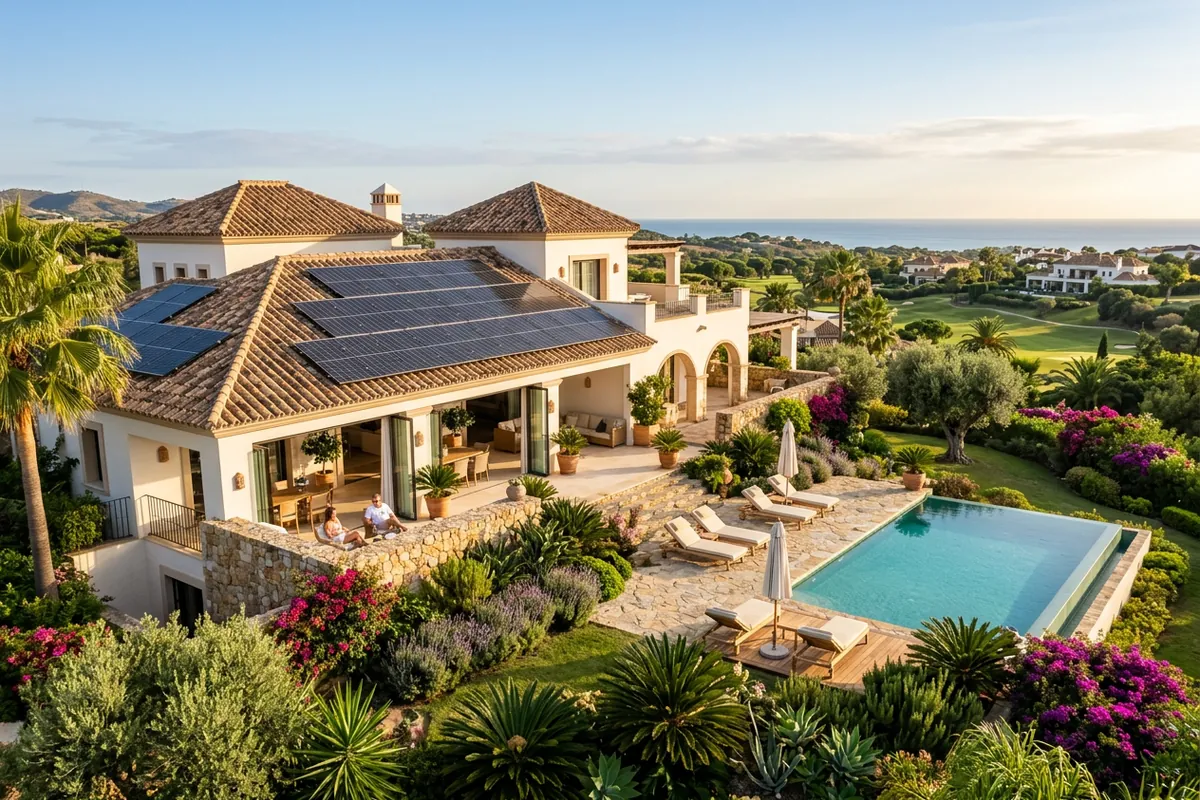
- A 10 kWp to 15 kWp Solar PV System: Consisting of 22 to 34 high-efficiency, marine-grade monocrystalline panels.
- A Hybrid Inverter: Equipped with dual MPPT (Maximum Power Point Tracking) to handle shading from mature cork oaks or palms.
- A Lithium-ion Battery Storage System (10 kWh to 20 kWh): Crucial for storing daytime solar surplus to power the aerotermia system’s heating cycle overnight.
- An 11 kW to 16 kW Aerotermia Heat Pump: Replacing the old gasoil boiler, integrated directly into the existing underfloor heating manifold.
The International Owner Profile: Operational Realities
Sotogrande has a permanent resident population of approximately 2,600 to 3,300 year-round inhabitants (rising from 2,584 in the 2020 INE census to an estimated 3,266 by 2024/25). However, during the peak summer polo and golf season, the population swells to an estimated 12,500.
The municipality of San Roque has a registered foreign resident population of approximately 13%, but within the gated perimeter of Sotogrande itself, the percentage of foreign-owned properties is vastly higher. The community is highly international, led by British and Gibraltar-linked residents, followed by Scandinavian (Swedish, Danish, Norwegian), German, Dutch, and Belgian owners.
For these international and often non-resident owners, managing a major energy installation remotely requires absolute trust and clear communication.
1. Remote Project Management
As bilingual brokers, we act as the single point of contact on-site. We coordinate with registered local engineering firms, secure the necessary municipal certificates, and provide regular photo and video updates. Owners do not need to fly in to manage the installation or deal with local municipal technicians.
2. Legal and Fiscal Steps
Before any installation begins, we ensure all legal foundations are secure:
- NIE and Representation: Non-resident owners must have a valid NIE (Spanish tax identification number) and a designated representative or gestor to handle the municipal tax filings.
- IBI Deductions: The Ayuntamiento de San Roque periodically offers incentives, including temporary reductions of up to 50% on the Impuesto sobre Bienes Inmuebles (IBI, property tax) for residential properties that install certified solar PV systems. We coordinate with local administrative managers to ensure these applications are submitted correctly alongside the final licencia de primera ocupación or work completion certificate.
- Grid Connection (Legalización): To sell excess solar energy back to the grid (compensation), the system must be officially registered (legalizado) with the Delegation of the Ministry of Industry in Cádiz and the utility provider (Endesa/e-distribución). This process requires an official installer's certificate (boletín) and can take between 4 to 12 weeks to process.
3. Maintenance and Protection
Given the coastal environment, regular maintenance is vital. Solar panels in Sotogrande must be washed at least twice a year to remove salt crusting and Saharan dust (calima), which can reduce panel efficiency by up to 30%. Aerotermia outdoor units require annual anti-corrosion treatments on their evaporator coils to protect against the relentless Levante wind.
Investing in the Future of Sotogrande
Transitioning your Sotogrande property to solar PV and aerotermia is not just an environmental choice; it is a highly strategic financial investment. It modernizes the villa's infrastructure, eliminates reliance on volatile fossil fuels, improves the property's Energy Performance Certificate (EPC) rating—which is increasingly important for high-net-worth buyers—and ensures compliance with Spain’s evolving environmental regulations.
By combining premium-spec, marine-grade hardware with diligent adherence to the guidelines of the San Roque Ayuntamiento and the Sotogrande EUC, international owners can enjoy seamless, worry-free energy independence in one of Europe’s most exclusive residential destinations.
Frequently Asked Questions
How much does Solar Panel Installation in Sotogrande cost? ▼
The typical fee for Solar Panel Installation in Sotogrande is EUR 5,000–15,000 for residential system. We provide a transparent quote before any commitment.
Do you cover Sotogrande and surrounding areas? ▼
Yes, we connect you with vetted professionals covering Sotogrande and all nearby towns including Manilva, Estepona.
How long does Solar Panel Installation take? ▼
Processing times vary, but most Solar Panel Installation cases in the Sotogrande area are completed within 2-8 weeks depending on complexity.
Other Home Services in Sotogrande
Property Management in Sotogrande
Already own a property? We manage holiday rentals, long-term lets, and keyholding.
View Property Management in Sotogrande →Get Your Free Property Assessment
Tell us your name and how to reach you. We respond within 2 hours.
or message us directly
WhatsApp Us Now