Garden & Landscape Maintenance in Manilva
Professional garden and landscape maintenance for Costa del Sol properties.
Managing Gardens and Landscaping in Manilva: The Practical Guide for International Villa and Community Owners
As the founder of costadelsolhabitat.com, I have spent years acting as the trusted bridge between international property owners and the specialized local trade services required to keep Mediterranean homes in pristine condition. Over this time, I have coordinated everything from emergency plumbing repairs to complete landscape overhauls.
When you cross into the Comarca of the Costa del Sol Occidental and reach Manilva—the southwestern gateway of the Málaga province bordering Cádiz—you encounter a highly specific microclimate and regulatory landscape. Managing a garden, terrace, or community green space here is vastly different from doing so in Marbella, let handwriting a project in northern Europe.
With a municipal register (padrón) showing 18,818 residents as of October 2024 (according to the Ayuntamiento de Manilva based on INE data, which officially records between 17,157 and 17,551 year-round residents), this municipality experiences a massive seasonal shift. During the peak summer months, our population triplicates. Furthermore, with approximately 40.5% of our registered population consisting of foreign residents (representing 7,114 individuals from 93 different nationalities), Manilva stands as one of the most internationalized municipalities in Málaga.
The British community represents the largest share of foreign property owners (2,801 residents), followed by Moroccans (854), Romanians (489), Italians (300), Bulgarians (165), Germans (160), Belgians (159), Argentines (149), Poles (129), and Swedes (127). For this diverse expat profile—composed heavily of retirees, second-home owners, and buy-to-let investors—maintaining outdoor spaces in urbanizations like Los Hidalgos, Jardines del Golf, Cármenes del Hacho, or Aldea Beach requires navigating high salinity, intense winds, strict coastal laws, and complex community rules.
The Manilva Microclimate: Winds, Salitre, and Intense UV
To design and maintain a thriving garden or terrace in Manilva, you must first understand the unique geography of this coastal-to-inland transition zone. Rising from the Mediterranean shore up to the Cerro del Hacho at 140 meters above sea level, our landscape features steep hillsides famous for Moscatel de Alejandría grape vineyards looking out over Gibraltar and the North African coast.
This geography exposes our properties to distinct environmental pressures:
- The Wind Regime (Levante vs. Poniente): Because of our immediate proximity to the Strait of Gibraltar, Manilva is notably windier than the central or eastern parts of the Costa del Sol. We experience the damp, humid Levante (east wind) which carries heavy moisture from the sea, and the drier, warmer Poniente (west wind). This constant air movement accelerates soil evaporation and physically batters delicate plants.
- High Salinity (Salitre): Along our 8 kilometers of coastline—affecting frontline properties in San Luis de Sabinillas, Castillo de la Duquesa (El Castillo), Puerto de la Duquesa, and Chullera—the air is thick with marine salt. This salitre deposits directly onto foliage, burning non-tolerant plants, and rapidly corrodes metal outdoor furniture, pergola brackets, and lighting fixtures.
- Intense Solar Radiation: With approximately 2,900 hours of sunshine per year and summer highs reaching 31 degrees Celsius, our low latitude (36°N) results in an extremely high summer UV index of 9 to 10. This intense sunlight degrades plastics, fades outdoor fabrics, and scorches lawns that are not adapted to the heat.
- Water Scarcity: While we receive roughly 600 mm of rain annually, it falls almost exclusively between November and March. Summers are bone-dry, meaning water conservation is a critical operational priority.
Plant Selection for Manilva Gardens
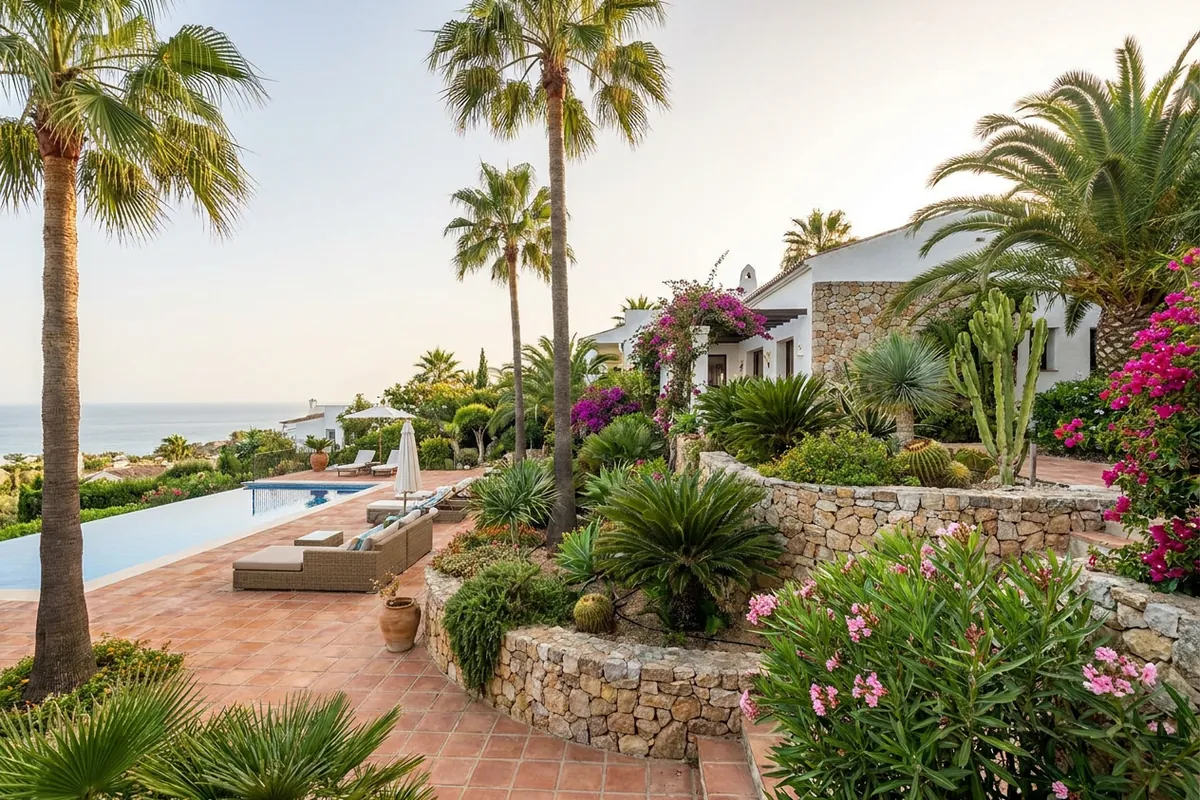
To build a resilient garden in developments like Cortijos del Golf or Marina del Castillo, we steer clients away from water-thirsty Northern European lawns and delicate flowering plants. Instead, we prioritize:
- Salt-Tolerant Species: Metrosideros excelsa (New Zealand Christmas Tree), Nerium oleander (Adelfa), Tamarix, and Carpobrotus edulis (Ice plant) for frontline coastal zones like Aldea Beach.
- Wind-Resistant and Mediterranean Native Plants: Olive trees (Olea europaea), Rosemary (Salvia rosmarinus), Lavender, and Bougainvillea, which handle both the Levante wind and dry spells beautifully.
- Drought-Tolerant Turf: Replacing traditional English Ryegrass with warm-season grasses like C4 Bermuda (Cynodon dactylon) or Paspalum, which can tolerate brackish irrigation water and go dormant rather than dying during extreme heat.
Navigating Local Regulations: Urbanismo, Ley de Costas, and Community Rules
Before you install a pergola, lay artificial turf, or build an outdoor kitchen in your villa garden, you must secure the correct legal permissions. In Spain, unauthorized outdoor alterations can result in heavy fines, forced demolition, and complications when selling the property.
1. The Ayuntamiento de Manilva and the PGOU
All urban planning and building permits are managed by the Gerencia Municipal de Urbanismo under the current PGOU (General Plan of Urban Planning, dating back to 1994 with subsequent general urban planning regulations).
- Obra Menor (Minor Works) via Declaración Responsable: For non-structural, reversible outdoor improvements—such as installing removable wooden or aluminum pergolas, fitting pull-down awnings (toldos), laying artificial turf over existing concrete, or minor garden tiling—you do not need to wait months for a formal license. Instead, you submit a Declaración Responsable (Responsible Declaration) via the municipality’s electronic office (sede electrónica). This notifies the town hall that you are commencing work that complies with local codes, allowing you to start immediately upon payment of the municipal tax (typically around 2% to 4% of the estimated construction material cost).
- Obra Mayor (Major Works): If your landscaping project involves structural changes, such as building a permanent brick outdoor kitchen with a concrete foundation, erecting glass curtains that alter the closed volume of the property, or excavating a new swimming pool, you must submit a full Obra Mayor project designed by an architect. This requires formal approval from the Gerencia Municipal de Urbanismo, a process that can take anywhere from 3 to 9 months.
2. The Spanish Coastal Law (Ley de Costas)
Because Manilva features 8 kilometers of coastline, properties situated near the beach in Sabinillas, El Castillo, Puerto de la Duquesa, or Punta Chullera fall under the jurisdiction of the Ley de Costas (Coastal Law).
This law establishes a protection easement zone (servidumbre de protección) which is generally 100 meters deep from the high-tide line (though it can be reduced to 20 meters in consolidated urban land designated before 1988). Within this zone, and within the 6-meter transit easement (servidumbre de tránsito), any new construction, major landscaping, or permanent installations require direct authorization from the Demarcación de Costas de Andalucía-Mediterráneo. The local PGOU itself had to undergo strict reporting from the Coastal Authority. If your villa sits on the cliffs of Chullera or the sands of Sabinillas, do not assume a municipal permit is enough; check your coastal boundaries first.
3. Comunidad de Propietarios (Community of Owners)
If your property is located within an organized community—such as Residencial Duquesa or complexes surrounding La Duquesa Golf—you are bound by the Ley de Propiedad Horizontal (Horizontal Property Law).
Any modification that affects the external aesthetic of the building or urbanization (including the color of awnings, the height of perimeter hedges, the installation of glass curtains on terraces, or erecting pergolas) must be approved by the Community of Owners. Even if the Ayuntamiento accepts your Declaración Responsable, the community can legally force you to dismantle any installation that violates the community's bylaws or alters the uniform architectural aesthetic. Always secure written approval from the community president or administrator before purchasing materials.
Essential Maintenance: Pests, Salitre, and Property Management
Maintaining a property in Manilva as a non-resident owner requires a proactive, year-round strategy. Leaving a villa or ground-floor apartment unattended for months at a time can result in costly damage.
Pest Control and Seasonal Hazards
- Processionary Caterpillars (Procesionaria del Pino): If your garden or neighboring plots in areas like Los Hidalgos have pine trees, you must be vigilant. Between January and April, these caterpillars descend from their silk nests in the branches to the ground. Their microscopic hairs carry a highly toxic protein that causes severe allergic reactions in humans and can be fatal to dogs. Annual preventive trunk injections (endotherapy) in autumn are highly recommended to eliminate the larvae before they nest.
- Termites and Wood-Boring Insects: The high humidity of the coastal environment combined with warm soils makes subterranean termites a threat to wooden pergolas, decking, and door frames. All outdoor timber must be pressure-treated (Class 4 autoclave) and treated annually with insecticidal and fungicidal sealants.
- Bird-Proofing: The coastal cliffs and port infrastructure mean seagulls and pigeons are highly active. Unprotected balconies and pergolas can quickly become nesting sites, leading to acidic droppings that damage paintwork and outdoor fabrics. Installing discreet netting, stainless steel spikes, or ultrasonic deterrents during the off-season is a standard property management practice.
Combating Salitre and Wind Damage
To protect your outdoor investments from the corrosive Levante winds:
- Hardware and Fixtures: Insist on marine-grade A4 (316) stainless steel for all outdoor screws, brackets, and hinges. Standard galvanized steel will rust within a single winter season in frontline developments like Marina del Castillo.
- Outdoor Furniture Protection: Store cushions indoors when the property is unoccupied. Invest in heavy-duty, breathable, UV-stabilized polyester covers that anchor firmly to the furniture frames to prevent them from being blown into the pool or over the terrace wall during high-wind Poniente events.
- Power Washing: Program your property manager to wash down terraces, glass balustrades, and outdoor furniture with fresh water at least once a month during the dry season to remove accumulated salt crusts and dust from the Sahara (calima).
The Legal and Practical Realities of Cross-Border Property Ownership
For our international community—whether you are a UK citizen navigating post-Brexit 90-day stay limitations, or a Swedish retiree spending the winter months in Jardines del Golf—managing a Spanish estate involves clear administrative steps.
If you are undertaking a major garden renovation or pool installation, you will interact with several local professionals:
- The Gestor / Abogado (Legal Representative): Your gestor or lawyer will handle the application for your NIE (tax identification number), verify that the property title is clear of historical planning infractions, and submit the necessary tax declarations for construction work.
- The Notary: If you are structuring your property ownership through a cross-border estate or inheritance plan (e.g., UK-Spain or Germany-Spain joint ownerships), any permanent structural additions that increase the registered built area of the villa must eventually be declared before a Notary via a Declaración de Obra Nueva (Declaration of New Work) to update the Property Registry (Registro de la Propiedad).
- The Property Manager: For buy-to-let investors operating with a tourist licence (licencia de primera ocupación and registration with the Registro de Turismo de Andalucía), maintaining immaculate outdoor spaces is directly tied to guest reviews and rental yields. A professional property manager coordinates regular pool cleaning, garden upkeep, and emergency repairs, ensuring that your investment remains compliant with local safety and hygiene standards while you are abroad.
By understanding the unique interplay of Manilva’s microclimate, coastal geography, and local administrative frameworks, you can protect your investment, avoid costly municipal disputes, and create an outdoor living space that thrives for years to come on this beautiful stretch of the Costa del Sol.
Frequently Asked Questions
How much does Garden & Landscape Maintenance in Manilva cost? ▼
The typical fee for Garden & Landscape Maintenance in Manilva is EUR 100–300/month. We provide a transparent quote before any commitment.
Do you cover Manilva and surrounding areas? ▼
Yes, we connect you with vetted professionals covering Manilva and all nearby towns including Estepona, Sotogrande.
How long does Garden & Landscape Maintenance take? ▼
Processing times vary, but most Garden & Landscape Maintenance cases in the Manilva area are completed within 2-8 weeks depending on complexity.
Other Home Services in Manilva
Property Management in Manilva
Already own a property? We manage holiday rentals, long-term lets, and keyholding.
View Property Management in Manilva →Also Serving Nearby
Get Your Free Property Assessment
Tell us your name and how to reach you. We respond within 2 hours.
or message us directly
WhatsApp Us Now